Written by
Consultant Psychiatrist and Addiction Specialist
MBBS — University of Health Sciences (UHS); MD Psychiatry — King Edward Medical University (KEMU); MPH — Institute of Public Health (IPH); UNODC Certified Addiction Specialist; International Certification of Addiction Professionals (ICAP-P); Formal training/fellowship in Child & Adolescent Psychiatry — King Edward Medical University, Lahore
View profileApproved by
Dr. Muhammad Shoaib Zafar
Super Admin
- Published:
- Last updated:
- Approved:
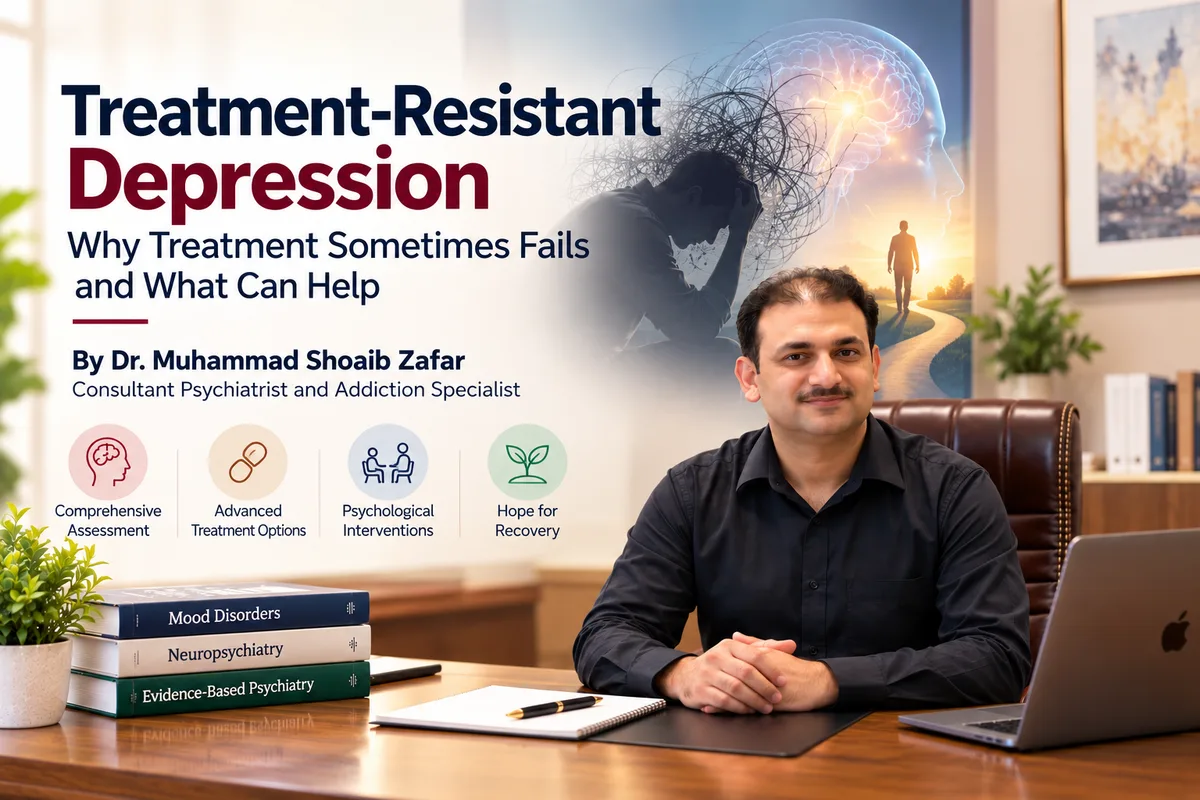
Treatment-Resistant Depression: Why Treatment Sometimes Fails and What Can Help
Author: Dr. Muhammad Shoaib Zafar Consultant Psychiatrist & Addiction Specialist | Lahore, Pakistan
Depression can be exhausting, particularly when a person has tried medication, attended therapy, followed medical advice, and still does not feel better. Families may begin to lose hope, while patients often blame themselves for not recovering.
But depression that persists despite treatment does not mean that recovery is impossible.
Treatment-resistant depression (TRD) is a clinical challenge that requires a careful reassessment of the diagnosis, previous treatments, contributing factors and available evidence-based options. With an individualised treatment plan, many people who have not responded adequately to initial treatment can still make meaningful progress.
What is treatment-resistant depression?
Treatment-resistant depression generally refers to major depressive disorder that has not responded adequately to at least two antidepressant trials given at appropriate doses and for sufficient durations, with reasonable adherence.
However, definitions vary across clinical guidelines and research studies.
Before applying this label, a psychiatrist should establish whether previous treatments were genuinely adequate and whether the original diagnosis remains correct.
For example, someone who stopped medication after a few days because of nausea has not necessarily completed an adequate treatment trial. Similarly, an antidepressant taken at a very low dose may not provide a fair assessment of its potential benefit.
It is also important to distinguish between partial response, no response and relapse after an initial improvement. These situations may require different treatment strategies.
Why does depression sometimes fail to respond?
Depression is not a single, uniform condition. Several factors can influence how a person responds to treatment.
1. The diagnosis needs reassessment
Symptoms that resemble depression may occur in bipolar disorder, post-traumatic stress disorder, anxiety disorders, substance-related conditions and certain medical illnesses. A history of unusually elevated mood, reduced need for sleep or episodes of increased energy may suggest bipolar disorder, in which treatment choices differ.
2. The treatment trial may not have been adequate
The medication, dose, duration, consistency of use and tolerability all matter. Some patients discontinue treatment because of adverse effects, cost, stigma or concerns about dependence. These barriers deserve a practical solution rather than criticism.
3. Other conditions may be maintaining symptoms
Chronic pain, thyroid disorders, sleep apnoea, problematic alcohol or drug use, and some medications can contribute to depressive symptoms.
A targeted medical assessment can identify relevant, treatable factors.
4. Psychological and social difficulties may remain unresolved
Grief, relationship conflict, financial pressure, trauma, loneliness and persistent stress can complicate recovery. Medication may be helpful, but it cannot always address every factor affecting a person’s life.
For this reason, persistent depression should prompt a comprehensive review—not simply the addition of another medicine.
Evidence-based treatment options for treatment-resistant depression
There is no single treatment that works best for everyone. The choice depends on previous treatment response, symptom severity, coexisting conditions, patient preference, safety and local availability.
1. Optimising or changing antidepressant medication
The first step may be to optimise a current antidepressant, if it has produced partial improvement and is well tolerated. In other cases, switching to a different antidepressant with a different mechanism of action may be appropriate.
The decision should consider previous benefits, side effects, drug interactions, medical conditions and the person’s priorities.
Repeatedly changing medicines without documenting symptoms and response can make it difficult to identify what is helping. Standardised rating scales, such as the PHQ-9, can help track progress alongside a clinical interview.
2. Combination treatment and augmentation
When an antidepressant provides only partial benefit, a psychiatrist may consider adding another treatment rather than replacing the original medicine.
Depending on the clinical situation, options include selected second-generation antipsychotics, lithium augmentation or combining medication with structured psychotherapy. These approaches have different evidence bases and safety requirements.
For example, lithium requires appropriate blood monitoring, assessment of kidney and thyroid function, and careful review of interactions.
Antipsychotic augmentation may require monitoring of weight, glucose, lipids and other adverse effects.
A 2025 pragmatic randomised trial published in The Lancet Psychiatry compared lithium with quetiapine augmentation over 12 months, highlighting the importance of considering both clinical effectiveness and tolerability when selecting longer-term treatment.
These medicines should only be used following an individual clinical assessment and appropriate monitoring.
3. Evidence-based psychotherapy
Psychotherapy remains an important component of care, including for people whose depression has not responded adequately to medication.
Cognitive behavioural therapy (CBT) can help identify and modify patterns of thinking and behaviour that maintain depression.
Depending on the person’s needs, interpersonal psychotherapy, behavioural activation and other structured psychological interventions may also be appropriate.
Therapy is not simply about being positive or talking through problems. It involves working towards specific goals, practising new skills and addressing patterns that interfere with recovery.
For some patients, combining psychotherapy with medication offers a more comprehensive approach than relying on either intervention alone.
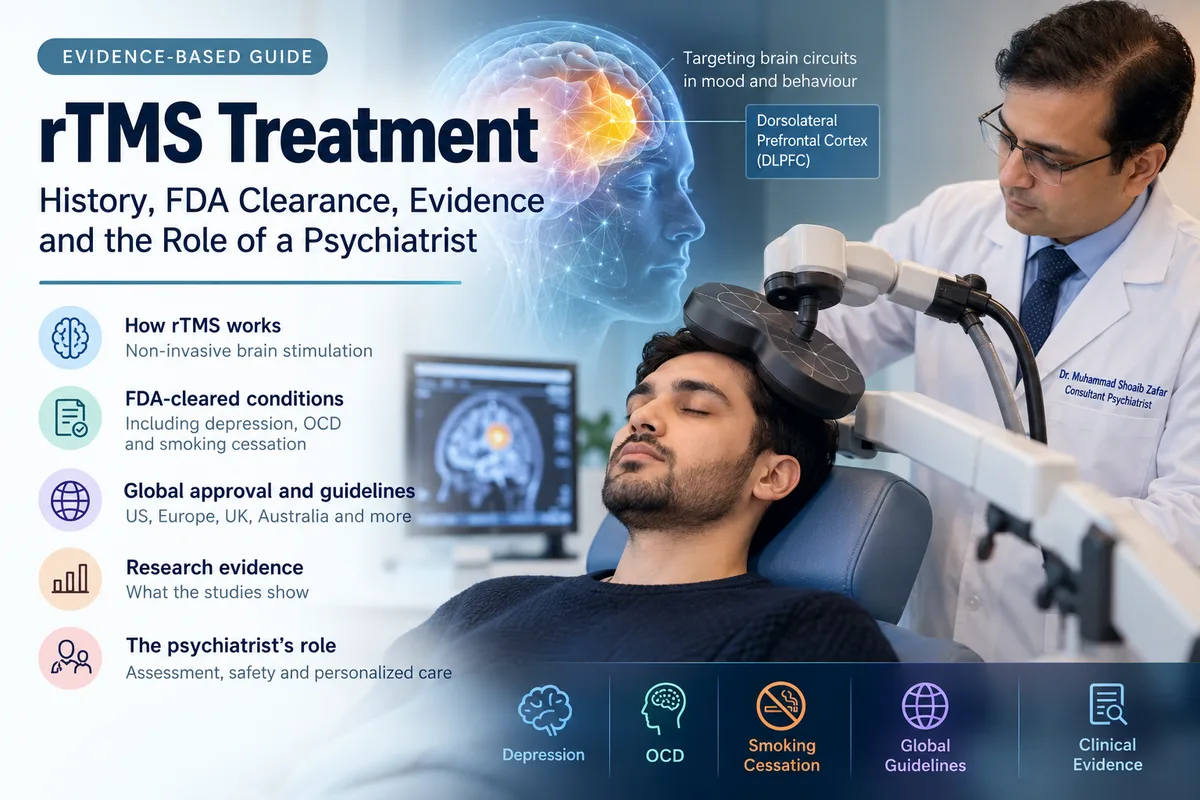
4. Repetitive transcranial magnetic stimulation (rTMS)
Repetitive transcranial magnetic stimulation uses magnetic pulses to stimulate targeted brain regions involved in mood regulation. It is a non-invasive treatment that does not require general anaesthesia.
Clinical trials and systematic reviews support rTMS as an option for treatment-resistant depression. Theta-burst stimulation, a form of patterned stimulation, may offer shorter treatment sessions in appropriate patients.
Treatment generally involves repeated sessions over several weeks. Headache and scalp discomfort are common adverse effects; seizures are rare but important to discuss during screening.
The expected benefit depends on the stimulation protocol, patient characteristics, previous treatment history and quality of the treatment service. rTMS is not a guaranteed cure, and maintenance or further treatment may be needed if symptoms return.
5. Ketamine and esketamine
Ketamine and esketamine have attracted considerable interest because they can produce relatively rapid improvement in depressive symptoms in some patients.
Ketamine is commonly administered intravenously in specialist settings for this indication, whereas esketamine is available as a regulated nasal treatment in certain countries and clinical settings. Their approvals, availability and prescribing requirements differ by jurisdiction.
A 2025 individual-patient-data meta-analysis of seven randomised trials involving 1,505 participants found a statistically significant but relatively small average benefit for intranasal esketamine combined with an antidepressant at four weeks.
Sedation and dissociation were more frequent with esketamine than with placebo.
This evidence illustrates why promising treatments should be discussed realistically. Some patients benefit substantially, while others do not respond or cannot tolerate treatment.
Ketamine-based treatments require careful screening and monitoring, particularly for blood-pressure changes, dissociation, misuse risk and other relevant contraindications.
They should not be confused with unsupervised ketamine use or recreational drug use.
6. Electroconvulsive therapy (ECT)
ECT is an established treatment for severe depression, including selected cases of treatment-resistant depression. It may be particularly important when depression is accompanied by psychotic symptoms, severe nutritional compromise, catatonia or an urgent need for a rapid response.
The procedure is performed under general anaesthesia with muscle relaxation. Temporary confusion, headache and memory difficulties can occur; cognitive effects should be discussed carefully before treatment.
Although stigma surrounding ECT persists, modern ECT is a medically supervised intervention with a substantial evidence base. For an appropriately selected patient, it may offer benefits that outweigh its risks.
What does the latest evidence tell us?
A 2025 systematic review and network meta-analysis in Neuropsychopharmacology evaluated 69 randomised trials involving 10,285 participants. It found evidence supporting several options, including ECT, rTMS, theta-burst stimulation, ketamine and selected augmentation approaches. However, differences between studies and variation in evidence quality mean that results should not be interpreted as a universal ranking of treatments.
The practical lesson is that treatment-resistant depression should be approached systematically. Advanced treatments can be valuable, but careful diagnosis, adequate treatment trials, measurement of outcomes and individualised decision-making remain essential.
When should specialist assessment be urgent?
Seek urgent medical assessment if depression is accompanied by suicidal thoughts, inability to maintain food or fluid intake, severe self-neglect, psychotic symptoms or possible catatonia.
If there is immediate danger of self-harm, do not leave the person alone; seek emergency assistance.
Recovery remains possible
A diagnosis of treatment-resistant depression does not mean that a person is beyond help. It means that the next stage of treatment deserves greater precision.
The most useful starting point is often a detailed review of previous medicines and therapies, the pattern of symptoms, coexisting conditions, daily functioning and personal treatment goals.
From there, a psychiatrist can develop a plan that may involve medication optimisation, augmentation, psychotherapy, neuromodulation or other specialist interventions.
Recovery may not always be immediate or linear. Nevertheless, a structured, evidence-based approach can help patients and families move beyond repeated unsuccessful treatment attempts towards a more informed plan.
About the author
Dr. Muhammad Shoaib Zafar is a Consultant Psychiatrist and Addiction Specialist based in Lahore, Pakistan. His clinical interests include mood disorders, addiction psychiatry, dual diagnosis and individualised psychiatric treatment.
Medical disclaimer: This article is for educational purposes and does not replace a personal psychiatric assessment.
Medication changes, augmentation strategies and advanced treatments should be discussed with a qualified clinician.
References
1. National Institute for Health and Care Excellence (NICE). Depression in adults: treatment and management. Guideline NG222, 2022; reviewed January 2026. https://www.nice.org.uk/guidance/ng222 2. Relative effectiveness of antidepressant treatments in treatment-resistant depression: a systematic review and network meta-analysis of randomized controlled trials.
Neuropsychopharmacology. 2025;50:913–919. https://doi.org/10.1038/s41386-024-02044-5 3. Clinical and cost-effectiveness of lithium versus quetiapine augmentation for treatment-resistant depression. The Lancet Psychiatry. 2025;12(4):276–288. https://doi.org/10.1016/S2215-0366(25)00028-8 4. Comparative efficacy and safety of intravenous racemic ketamine, repetitive transcranial magnetic stimulation and electroconvulsive therapy for Stage 2 or higher treatment-resistant depression: a systematic review and network meta-analysis.
Psychiatry and Clinical Neurosciences Reports. 2025. https://doi.org/10.1002/pcn5.70136 5. Efficacy and safety of esketamine for treatment-resistant depression: registered report for a systematic review with an individual patient data meta-analysis of randomized, double-blind, placebo-controlled trials. BMC Medicine. 2025;23:478654. https://doi.org/10.1186/s12916-025-04435-x
Frequently Asked Questions
What does this article explain about Treatment-Resistant Depression: Why Treatment Sometimes Fails and What Can Help Author: Dr?
Treatment-Resistant Depression: Why Treatment Sometimes Fails and What Can Help Author: Dr. Muhammad Shoaib Zafar Consultant Psychiatrist & Addiction Specialist | Lahore, Pakistan Depression can be exhausting, particularly when a person has tried medication, attended therapy, followed medical advice, and still does not feel better.
About the author
Consultant Psychiatrist and Addiction Specialist
MBBS — University of Health Sciences (UHS); MD Psychiatry — King Edward Medical University (KEMU); MPH — Institute of Public Health (IPH); UNODC Certified Addiction Specialist; International Certification of Addiction Professionals (ICAP-P); Formal training/fellowship in Child & Adolescent Psychiatry — King Edward Medical University, Lahore
King Edward Medical University (KEMU) & Mayo Hospital, Lahore
clinical interests
Adult Psychiatry; Addiction Psychiatry & Rehabilitation; Child & Adolescent Psychiatry; Psychotherapy & Psychological Interventions; Psychiatric Assessment & Consultation
training
Formal training/fellowship in Child & Adolescent Psychiatry, King Edward Medical University, Lahore
memberships
Pakistan Medical & Dental Council (PMDC); Pakistan Psychiatric Society (PPS); International Certification of Addiction Professionals (ICAP)
Dr. Muhammad Shoaib Zafar, MBBS, MD (Psychiatry) Assistant Professor of Psychiatry, King Edward Medical University (KEMU), Lahore