
Written by
Consultant Psychiatrist and Addiction Specialist
MBBS — University of Health Sciences (UHS); MD Psychiatry — King Edward Medical University (KEMU); MPH — Institute of Public Health (IPH); UNODC Certified Addiction Specialist; International Certification of Addiction Professionals (ICAP-P); Formal training/fellowship in Child & Adolescent Psychiatry — King Edward Medical University, Lahore
View profileApproved by
Dr. Muhammad Shoaib Zafar
Super Admin
- Published:
- Last updated:
- Approved:
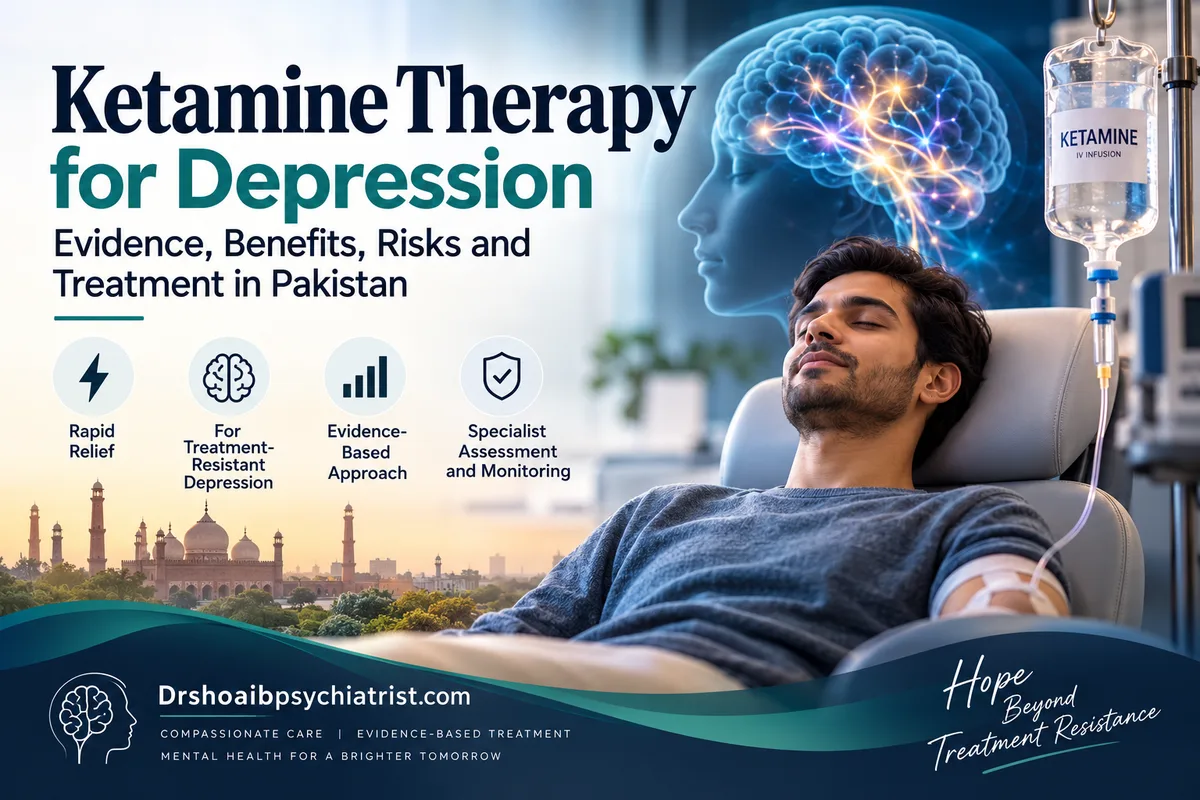
Ketamine Therapy for Depression: Evidence, Benefits, Risks and Treatment in Pakistan
Author: Dr. Muhammad Shoaib Zafar Specialty: Psychiatry and Addiction Treatment Location: Lahore, Pakistan Last medically reviewed: 24 October 2026
Introduction: A new approach to treatment-resistant depression
Depression is a common mental health condition that can affect mood, motivation, sleep, concentration, relationships, work and overall quality of life.
Although many patients improve with antidepressant medication and psychotherapy, some continue to experience significant symptoms despite receiving appropriate treatment.
For these individuals, ketamine therapy has emerged as a potential treatment option for treatment-resistant depression (TRD). Unlike conventional antidepressants, which primarily influence monoamine neurotransmitter systems, ketamine acts on glutamate-related pathways involved in communication and plasticity between brain cells.
Research suggests that ketamine can produce a rapid reduction in depressive symptoms in some carefully selected patients. However, it is not a universal treatment for depression, and its long-term effectiveness, optimal maintenance schedule and safety with repeated administration remain important areas of research.
For patients in Lahore and across Pakistan, understanding the evidence, available treatment approaches, potential risks and importance of specialist assessment is essential before considering ketamine therapy.
What is ketamine therapy?
Ketamine is a medication originally developed and widely used for anaesthesia. At lower, subanaesthetic doses, it has demonstrated antidepressant effects in clinical studies.
In psychiatric practice, two formulations are particularly important:
* Intravenous (IV) racemic ketamine: A mixture of the R- and S-enantiomers, administered through a controlled infusion in a medically supervised setting.
Its use for depression is generally off-label. * Intranasal esketamine: A prescription formulation containing the S-enantiomer of ketamine. It has specific regulatory indications in certain countries and is administered under the applicable product requirements.
Although these treatments are pharmacologically related, they are not interchangeable.
Evidence, dosing, monitoring requirements, availability and regulatory status differ.
Ketamine therapy should be understood as a specialist medical intervention rather than a routine antidepressant or a treatment that patients can safely administer themselves.
How does ketamine work in the brain?
Ketamine is best known for its action as an antagonist of the N-methyl-D-aspartate (NMDA) receptor, a receptor involved in glutamate-mediated neurotransmission.
Glutamate is the brain’s principal excitatory neurotransmitter and contributes to learning, memory, emotional processing and synaptic plasticity.
Researchers believe ketamine’s antidepressant effects involve several interacting mechanisms:
1. Glutamate signalling: Ketamine alters NMDA receptor activity and downstream glutamatergic signalling. 2.
Synaptic plasticity: Changes in pathways involving AMPA receptors, brain-derived neurotrophic factor (BDNF) and related intracellular signalling may help support changes in synaptic function. 3. Neural network function: Changes in communication between brain networks may contribute to improvements in mood, cognition and emotional processing.
These mechanisms are still being investigated.
No single proposed mechanism fully explains the clinical effects of ketamine, and the relationship between its immediate psychoactive effects and antidepressant response remains incompletely understood.
Importantly, ketamine is not simply a stronger conventional antidepressant. It acts through different neurobiological pathways, which may help explain why it can benefit some patients who have not responded adequately to other treatments.
Who may benefit from ketamine therapy?
The strongest clinical evidence for IV racemic ketamine concerns adults with treatment-resistant depression.
Treatment-resistant depression generally refers to a major depressive episode that has not responded adequately to at least two appropriate antidepressant treatment trials. Assessment should establish whether previous treatments were prescribed at suitable doses and durations, taken consistently and evaluated adequately.
A psychiatrist may consider ketamine when a patient has:
* Persistent moderate-to-severe depression despite adequate treatment. * Failed to respond adequately to several evidence-based antidepressant strategies. * Significant functional impairment related to depression. * A clinical history suggesting that a rapid treatment effect could be valuable.
* A suitable medical and psychiatric profile for supervised treatment.
Before recommending ketamine, the psychiatrist should reassess the diagnosis, review previous treatments, evaluate possible bipolar disorder, identify substance use problems and consider alternative evidence-based interventions.
Ketamine is not automatically the next step after one unsuccessful antidepressant.
Treatment decisions should reflect the severity of illness, previous response, individual risks, patient preferences and available alternatives.
What does the scientific evidence show?
1. Rapid antidepressant effects
Clinical trials have demonstrated that IV ketamine can reduce depressive symptoms within hours in some patients with treatment-resistant depression.
This rapid onset is one of its most important potential advantages. Conventional antidepressants often require several weeks before their full effects can be assessed, whereas ketamine’s early effects may become apparent much sooner.
However, response varies considerably. Some patients experience substantial improvement, some experience partial improvement and others do not respond.
2. Evidence from clinical guidelines
The Canadian Network for Mood and Anxiety Treatments (CANMAT) published a task-force review of racemic ketamine in adults with major depressive disorder in 2021. It concluded that a single IV infusion had strong evidence for short-term antidepressant efficacy, while evidence for repeated courses and ongoing maintenance was more limited.
A 2026 interdisciplinary consensus guideline from the American Society of Ketamine Physicians, Psychotherapists, and Practitioners (ASKP3) further addressed patient selection, clinical assessment, treatment administration, monitoring, informed consent and follow-up.
The newer guidance supports a structured clinical approach but does not remove the remaining uncertainties about long-term outcomes.
3. How long do the benefits last?
A key limitation is that improvement following an infusion may be temporary. Symptoms can return over subsequent days or weeks, and individual patterns vary.
Repeated infusions may extend the period of improvement for some patients. Nevertheless, the evidence supporting long-term maintenance treatment is less robust than the evidence for short-term symptom reduction.
A responsible treatment plan therefore includes reassessment after each session, formal measurement of clinical outcomes and an explicit strategy for relapse prevention.
4. Does ketamine prevent suicide?
Ketamine has demonstrated rapid reductions in certain measures of suicidal ideation in some clinical studies. This is an important area of research, particularly for severe depression.
However, reducing suicidal thoughts in the short term is not equivalent to demonstrating prevention of suicide attempts or deaths.
Patients with imminent suicide risk require immediate, appropriate risk management, which may include emergency assessment, inpatient treatment and other evidence-based interventions. Ketamine must not delay or replace necessary protective care.
What happens during ketamine treatment?
Treatment should begin with a comprehensive assessment by a qualified psychiatrist and an appropriate medical evaluation.
Step 1: Psychiatric assessment
The psychiatrist evaluates depressive symptoms, previous treatment trials, current medications, suicide risk, psychiatric comorbidities, substance use and treatment goals.
A validated depression scale, such as the Montgomery–Åsberg Depression Rating Scale (MADRS) or Patient Health Questionnaire-9 (PHQ-9), can help establish a baseline and measure subsequent change.
Step 2: Medical screening
The clinical team reviews medical history, cardiovascular risk, blood pressure, current medications and other factors that could affect treatment safety.
An ECG and laboratory investigations may be indicated depending on the patient’s history and examination. Screening should be individualized rather than based on an indiscriminate panel of tests.
Step 3: Informed consent and preparation
Before treatment, the patient should understand the expected benefits, uncertainties, alternatives, possible adverse effects, costs and monitoring arrangements.
The clinician should explain the possibility of dissociation, changes in perception, transient increases in blood pressure, nausea and sedation.
Step 4: Supervised administration
IV ketamine is administered according to an authorized, individualized prescription in a clinical setting with appropriate physiological monitoring and emergency-response capability.
A commonly studied adult research regimen is 0.5 mg/kg infused over approximately 40 minutes. This is a description of a published research protocol, not a recommendation for self-treatment or a substitute for individualized medical prescribing.
Step 5: Recovery and discharge
After administration, the patient remains under observation until physiological and psychological recovery is adequate.
Discharge requires appropriate clinical assessment, written instructions, safe transport arrangements and a clear route for seeking help if symptoms worsen.
Step 6: Follow-up and outcome measurement
The psychiatrist evaluates symptom change, functioning, adverse effects and ongoing suicide risk. Subsequent treatment decisions depend on the response and the overall benefit–risk assessment.
What are the possible side effects and risks?
Ketamine can cause temporary effects during or after administration. The clinical team should explain these in advance and monitor for complications.
Potential adverse effects include:
* Dissociation: Feeling detached from the body, surroundings or usual sense of self. * Perceptual changes: Altered visual or auditory experiences.
* Cardiovascular effects: Temporary increases in blood pressure or heart rate. * Sedation and dizziness: Reduced alertness or impaired coordination. * Nausea or vomiting: Occasionally requiring clinical intervention. * Anxiety or distress: Some patients find the subjective experience uncomfortable. * Misuse and dependence risk: Particularly relevant to people with a history of ketamine misuse or other substance use disorders.
Repeated or prolonged exposure also raises concerns about urinary tract injury, cognitive effects and problematic use. The extent of these risks with supervised psychiatric treatment is not fully established.
Ketamine may be unsuitable or require additional specialist assessment in patients with uncontrolled hypertension, significant cardiovascular disease, conditions in which increased blood pressure would pose serious danger, active psychosis, unstable mania, pregnancy or clinically important respiratory risks.
A history of substance use disorder requires an individualized assessment rather than an automatic assumption that ketamine is either appropriate or inappropriate.
Ketamine versus conventional antidepressants
Feature Conventional antidepressants IV ketamine Mechanism Different classes affect monoamine and other neurotransmitter systems Primarily alters NMDA receptor and glutamate-related signalling
Onset Often several weeks for a full response Improvement may occur within hours in some patients Evidence base Extensive evidence for multiple depressive disorders Strongest for short-term effects in adult treatment-resistant depression Duration Maintenance treatment often helps prevent relapse Benefit may fade after an infusion or short course Administration Commonly taken at home as prescribed Requires supervised clinical administration
Main considerations Class-specific adverse effects, interactions and discontinuation issues Dissociation, cardiovascular changes, monitoring requirements and misuse risk
These treatments are not necessarily alternatives to one another. Depending on the clinical situation, ketamine may be considered alongside an appropriate ongoing treatment plan rather than as a complete replacement for antidepressants or psychotherapy.
Other options, including medication augmentation, evidence-based psychotherapy, electroconvulsive therapy (ECT) and approved neuromodulation treatments, should also be considered where appropriate.
IV ketamine and intranasal esketamine: What is the difference?
Although related, IV racemic ketamine and intranasal esketamine have distinct evidence and regulatory profiles.
IV racemic ketamine is generally used off-label for depression and requires a specialized clinical protocol. Intranasal esketamine has specific approved indications in certain jurisdictions, with product-specific administration, observation and risk-management requirements.
In the United States, for example, esketamine is subject to a restricted distribution and monitoring programme.
This authorization should not be interpreted as approval of IV racemic ketamine for depression, and neither country’s regulatory status should be assumed to apply automatically in Pakistan.
The choice between treatments depends on clinical eligibility, local availability, regulatory requirements, costs, patient preference and the treating psychiatrist’s assessment.
Is ketamine therapy available in Lahore, Pakistan?
Patients in Lahore and other parts of Pakistan should seek an assessment from a qualified psychiatrist experienced in treatment-resistant depression before considering ketamine treatment.
Availability of a medicine does not by itself establish that a facility is authorized or appropriately equipped to administer it for psychiatric purposes.
Before proceeding, patients should ask the treatment provider:
* Who will conduct the psychiatric and medical assessment? * What evidence supports the proposed treatment for the patient’s diagnosis? * Is the medicine obtained through an authorized supply chain? * What physiological monitoring and emergency arrangements are available? * How will treatment response and adverse effects be measured?
* What is the plan if the treatment does not work or symptoms return? * What are the total costs, including assessment, administration and follow-up?
The regulatory status of the specific medicine, prescribing arrangements, controlled-drug requirements and facility authorization should be verified under the applicable Pakistani and provincial rules.
Patients should avoid unsupervised ketamine use, unverified products and providers who promise guaranteed remission or permanent results.
How much does ketamine therapy cost in Pakistan?
The cost of treatment can vary substantially according to the clinical setting, medicine procurement, monitoring facilities, staffing, assessment requirements and follow-up arrangements.
A meaningful estimate should distinguish the cost of the initial psychiatric assessment from the cost of each administration, medical investigations, recovery monitoring and subsequent reviews.
Because local availability and pricing can change, patients should obtain a current, itemized quotation from an appropriately authorized provider rather than relying on an unverified online price.
Cost should not be the only factor in choosing a service. Clinical governance, transparent prescribing, emergency readiness and continuity of care are essential considerations.
What happens if ketamine treatment does not work?
Ketamine does not benefit every patient, and a lack of response should lead to reassessment rather than automatic dose escalation or indefinite treatment.
The psychiatrist may review the original diagnosis, adequacy of prior treatment, comorbidities, medication interactions, adverse effects and the patient’s treatment goals.
Depending on the clinical situation, alternative or additional approaches may include medication optimization, augmentation, structured psychotherapy, ECT or another appropriate evidence-based intervention.
For patients who improve, continued care should focus on sustaining functional gains, treating residual symptoms, strengthening coping skills and developing a relapse-prevention plan. Maintenance ketamine should be considered only when its potential benefits justify the risks and uncertainties.
Frequently asked questions about ketamine therapy
Can ketamine work after other antidepressants have failed?
Yes. Clinical trials support the use of IV ketamine for some adults with treatment-resistant depression. However, response is not guaranteed, and suitability depends on a comprehensive psychiatric and medical assessment.
How quickly can ketamine improve depression?
Some patients experience improvement within hours or by the following day. Others respond more gradually or do not respond.
The timing and magnitude of benefit vary.
Is one infusion enough?
Some patients improve after a single infusion, but the effect may not last. A course of treatment may be considered by the treating psychiatrist, while the optimal duration and maintenance schedule remain uncertain.
Is ketamine a permanent cure for depression?
No. Current evidence does not establish ketamine as a permanent cure.
Depression may recur, so follow-up and ongoing treatment remain important.
Is ketamine addictive?
Ketamine has misuse and dependence potential. The level of risk in supervised psychiatric treatment is not fully quantified, and careful screening and monitoring are particularly important for patients with a history of substance-related problems.
Can ketamine replace psychotherapy?
Not necessarily. Ketamine and psychotherapy serve different roles. Psychotherapy, medication management, social support and relapse-prevention strategies may all contribute to longer-term recovery.
Is ketamine suitable for children and adolescents?
Evidence remains insufficient to apply adult IV ketamine protocols routinely to children and adolescents.
Treatment in younger populations requires specialist assessment, an appropriate evidence base and specific clinical governance.
Does ketamine help with bipolar depression?
There is emerging evidence for ketamine in selected patients with bipolar depression, but the evidence base is more limited. Specialist assessment, attention to mood switching and an individualized treatment plan are essential.
Conclusion: An evidence-based, specialist approach to ketamine therapy
Ketamine represents an important development in the treatment of depression, particularly for adults who have not responded adequately to conventional treatment. Its potential to reduce depressive symptoms rapidly offers hope to some patients with persistent and disabling illness.
However, rapid improvement should not be confused with guaranteed recovery. Questions remain about long-term safety, relapse prevention, maintenance schedules and which patients are most likely to benefit.
The most appropriate approach is a comprehensive psychiatric assessment, informed decision-making, supervised administration, objective outcome measurement and continued care beyond the infusion itself.
For patients considering ketamine treatment in Lahore or elsewhere in Pakistan, the priority should be access to qualified psychiatric care, verified medication supply, appropriate clinical monitoring and a treatment plan tailored to the individual’s needs.
Medical consultation: Dr. Muhammad Shoaib Zafar, Consultant Psychiatrist and Addiction Specialist, provides psychiatric assessment and evidence-informed treatment planning.
Patients considering advanced treatments for depression should seek an individualized consultation to discuss diagnosis, available options, benefits, risks and suitability.
⸻
References
1. Swainson J, McGirr A, Blier P, et al. The Canadian Network for Mood and Anxiety Treatments (CANMAT) Task Force Recommendations for the Use of Racemic Ketamine in Adults with Major Depressive Disorder.
Canadian Journal of Psychiatry. 2021;66(2):113–125. Read the full article. DOI: 10.1177/0706743720970860. 2. Mathai DS, Cluck M, Aslam AM, et al. Interdisciplinary, Delphi-driven consensus guidelines on the use of intravenous ketamine infusions for depressive disorders from the American Society of Ketamine Physicians, Psychotherapists, and Practitioners (ASKP3).
Journal of Affective Disorders. 2026;411:121970. Read the publication. 3. Sanacora G, Frye MA, McDonald W, et al. A Consensus Statement on the Use of Ketamine in the Treatment of Mood Disorders. JAMA Psychiatry. 2017;74(4):399–405. Read the article. 4. U.S. Food and Drug Administration. SPRAVATO (esketamine) nasal spray: Prescribing Information. Access the prescribing information.
Editorial note: This article is for general educational purposes and does not replace an individualized medical assessment. Regulatory approvals and treatment availability vary by country. The publication date and references should be reviewed periodically as new evidence and guidance emerge.
Frequently Asked Questions
Who may benefit from ketamine therapy for depression?
The strongest evidence for IV ketamine concerns adults with treatment-resistant depression, generally meaning depression that has not responded adequately to at least two appropriate antidepressant trials. A psychiatrist should review previous treatments, medical history and individual risks before recommending it.
How quickly does ketamine work, and how long do benefits last?
Some patients experience reduced depressive symptoms within hours, while others have little or no improvement. Benefits may fade over days or weeks. Repeated infusions may help some patients, but evidence for long-term maintenance is more limited.
What are the possible side effects of ketamine therapy?
Possible effects include feeling detached from yourself or your surroundings, altered perceptions, temporary increases in blood pressure or heart rate, sedation, dizziness, nausea and anxiety. Misuse and dependence are also concerns, and the long-term risks of repeated supervised treatment are not fully established.
What assessment and monitoring are needed before and during treatment?
Treatment starts with psychiatric assessment and medical screening, including a review of previous treatments, medications, blood pressure and relevant health risks. Administration requires medical supervision, appropriate monitoring and emergency-response capability, followed by observation, safe transport arrangements and follow-up.
About the author
Consultant Psychiatrist and Addiction Specialist
MBBS — University of Health Sciences (UHS); MD Psychiatry — King Edward Medical University (KEMU); MPH — Institute of Public Health (IPH); UNODC Certified Addiction Specialist; International Certification of Addiction Professionals (ICAP-P); Formal training/fellowship in Child & Adolescent Psychiatry — King Edward Medical University, Lahore
King Edward Medical University (KEMU) & Mayo Hospital, Lahore
clinical interests
Adult Psychiatry; Addiction Psychiatry & Rehabilitation; Child & Adolescent Psychiatry; Psychotherapy & Psychological Interventions; Psychiatric Assessment & Consultation
training
Formal training/fellowship in Child & Adolescent Psychiatry, King Edward Medical University, Lahore
memberships
Pakistan Medical & Dental Council (PMDC); Pakistan Psychiatric Society (PPS); International Certification of Addiction Professionals (ICAP)
Dr. Muhammad Shoaib Zafar, MBBS, MD (Psychiatry) Assistant Professor of Psychiatry, King Edward Medical University (KEMU), Lahore