Written by
Consultant Psychiatrist and Addiction Specialist
MBBS — University of Health Sciences (UHS); MD Psychiatry — King Edward Medical University (KEMU); MPH — Institute of Public Health (IPH); UNODC Certified Addiction Specialist; International Certification of Addiction Professionals (ICAP-P); Formal training/fellowship in Child & Adolescent Psychiatry — King Edward Medical University, Lahore
View profileApproved by
Dr. Muhammad Shoaib Zafar
Super Admin
- Published:
- Last updated:
- Approved:
Repetitive Transcranial Magnetic Stimulation (rTMS): History, FDA Clearance, Evidence and the Role of a Psychiatrist
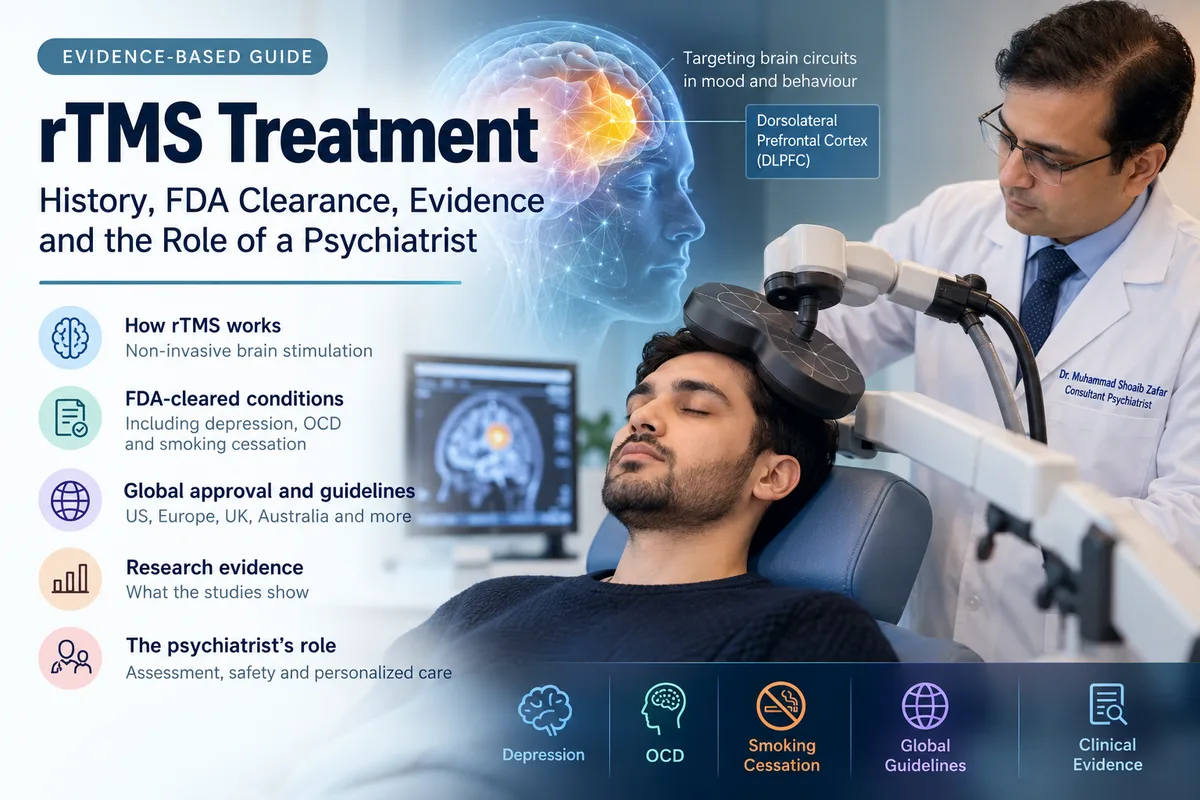
Repetitive transcranial magnetic stimulation (rTMS) is a non-invasive brain stimulation treatment that has become an important option in modern psychiatry, particularly for people with depression who have not benefited sufficiently from conventional treatment. It uses rapidly changing magnetic fields to stimulate selected brain circuits without surgery, general anaesthesia or the need to induce a seizure.
As research advances, rTMS is being investigated for obsessive-compulsive disorder (OCD), smoking cessation, bipolar depression, post-traumatic stress disorder (PTSD), addiction and several other psychiatric and neurological conditions. However, the strength of evidence and regulatory status differ substantially between indications.
Understanding the history, scientific evidence, approved uses and limitations of rTMS is essential for patients, families and healthcare professionals considering this treatment.
What is rTMS?
Repetitive transcranial magnetic stimulation is a non-invasive neuromodulation technique. A magnetic coil placed against the scalp generates brief magnetic pulses that induce electrical currents in targeted areas of the brain. These currents influence neuronal activity and the functioning of interconnected neural networks.
In depression, commonly targeted regions include the dorsolateral prefrontal cortex, which participates in mood regulation, executive functioning and emotional processing.
Different stimulation protocols have different effects. High-frequency stimulation and intermittent theta-burst stimulation are generally used to facilitate activity in selected circuits, while low-frequency stimulation may reduce activity in targeted regions. The therapeutic effect depends on the protocol, stimulation target, intensity, treatment schedule and individual clinical characteristics.
Unlike electroconvulsive therapy (ECT), rTMS does not intentionally induce a generalized seizure and ordinarily requires no anaesthesia. Unlike medication, it does not produce the same systemic drug exposure. Nevertheless, it is a medical treatment with potential adverse effects and requires appropriate clinical assessment.
A brief history of rTMS
The scientific foundations of magnetic stimulation developed during the twentieth century. In 1985, Anthony Barker and colleagues demonstrated that transcranial magnetic stimulation could non-invasively stimulate the human motor cortex, opening new possibilities for studying brain function.
Researchers subsequently explored repetitive stimulation as a method of influencing brain activity beyond brief diagnostic stimulation. During the 1990s, early clinical studies investigated its antidepressant effects, particularly through stimulation of the prefrontal cortex.
By the early 2000s, randomized controlled trials had begun to establish a stronger evidence base for depression. In October 2008, the United States Food and Drug Administration (FDA) cleared the first rTMS system for treating major depressive disorder in adults who had not achieved satisfactory improvement with antidepressant medication during the current episode.
Subsequent developments included different magnetic coil designs, stimulation targets and accelerated treatment protocols. Deep TMS systems received FDA authorization for specific additional indications, including OCD and smoking cessation, while newer protocols have shortened individual treatment sessions and, in some cases, the overall treatment course.
Today, rTMS is an established treatment option for appropriately selected patients with depression, although availability, approved indications and reimbursement vary between countries and devices.
Which conditions have FDA clearance for TMS or rTMS?
The FDA regulates specific medical devices and their stated indications. Therefore, the correct question is not simply whether “rTMS is FDA-approved,” but which device and protocol have been cleared for which condition and patient population.
Major depressive disorder
Depression is the best-established psychiatric indication for rTMS. FDA-cleared systems are available for major depressive disorder, particularly when antidepressant medication has not produced adequate improvement or has not been suitable for the patient.
Clinical trials and meta-analyses support the antidepressant efficacy of appropriately delivered rTMS. Treatment protocols may involve conventional high-frequency stimulation, low-frequency stimulation or intermittent theta-burst stimulation, depending on the device and clinical indication.
Some systems also have specific indications for depressive symptoms in patients with co-occurring anxiety, and certain systems have received clearance for adolescent depression in defined age groups. These indications must be checked against the relevant device label.
Obsessive-compulsive disorder
In 2018, the FDA permitted marketing of the BrainsWay Deep TMS system for OCD. The clearance followed a randomized, sham-controlled study showing a greater proportion of treatment responders with active stimulation than with sham treatment.
The treatment targets and protocols used for OCD differ from those commonly used for depression. OCD treatment may involve stimulation of circuits associated with compulsivity and related brain networks, sometimes alongside exposure and response prevention therapy and medication.
Evidence is encouraging, but results depend on the protocol and patient characteristics. The FDA clearance for a specific Deep TMS system should not be interpreted as blanket authorization for every rTMS device to treat OCD.
Smoking cessation
The FDA cleared the BrainsWay Deep TMS system as an aid for short-term smoking cessation in adults in 2020. This is a specific device indication, not evidence that all rTMS machines are approved for nicotine dependence or other substance use disorders.
Research into neuromodulation for addiction continues, including studies of craving and substance-use outcomes. At present, rTMS should not be represented as a universally established or FDA-cleared treatment for alcohol, opioid, stimulant or other substance use disorders.
Migraine
The FDA has cleared certain transcranial magnetic stimulation devices for particular migraine indications. Importantly, some migraine indications involve single-pulse TMS rather than repetitive TMS. These should not be conflated with psychiatric rTMS protocols.
Anxiety symptoms associated with depression
Certain TMS systems have specific FDA-cleared indications addressing anxiety symptoms in adults with major depressive disorder. This does not establish rTMS as a universally cleared treatment for every anxiety disorder, including generalized anxiety disorder, panic disorder or social anxiety disorder.
What about bipolar depression, PTSD and other conditions?
rTMS is being studied for bipolar depression, PTSD, schizophrenia, chronic pain, eating disorders and various addictive disorders. Evidence varies by condition and protocol. For example, some studies of bipolar depression have produced promising findings, but a device’s FDA breakthrough designation is not equivalent to FDA marketing clearance or approval for that indication.
Before offering treatment for any condition, clinicians should distinguish established clinical evidence from emerging research and verify the exact regulatory status of the device being used.
Is rTMS approved or recommended outside the United States?
rTMS has gained acceptance in several other healthcare systems, although the regulatory terminology differs.
* Australia: The Therapeutic Goods Administration (TGA) approved rTMS for depression in 2007. Australian professional guidance supports its use for appropriately selected patients. * Europe: TMS devices have obtained European conformity certifications for specified indications. The applicable regulatory framework and certification status depend on the device and its intended use. * United Kingdom: The National Institute for Health and Care Excellence (NICE) has published guidance on rTMS for depression and separate guidance on TMS for OCD. NICE guidance is not itself a device marketing authorization. * Canada: Canadian clinical practice guidelines recognize rTMS as a treatment option for major depressive disorder, including treatment-resistant presentations.
Regulatory approval, device certification, clinical guideline recommendations and reimbursement are different matters. A device authorized in one country is not automatically authorized for every indication in another country.
In Pakistan, the regulatory status of a specific rTMS system and its permitted clinical uses should be verified with the relevant authorities and the device manufacturer before clinical deployment.
What does research say about the effectiveness of rTMS?
The strongest evidence for rTMS concerns major depressive disorder, particularly depression that has not responded adequately to conventional treatment.
Randomized controlled trials comparing active stimulation with sham treatment have demonstrated clinically meaningful improvements in depressive symptoms. However, response and remission rates vary across studies because of differences in patient populations, treatment resistance, stimulation targets, protocols and outcome definitions.
A 2019 network meta-analysis published in The BMJ evaluated multiple brain-stimulation treatments for major depressive episodes and supported the effectiveness of several rTMS approaches. More recent clinical reviews have also summarized evidence supporting FDA-cleared protocols for depression.
For OCD, a randomized controlled trial of Deep TMS published by Carmi and colleagues in 2019 found a higher response rate with active stimulation than with sham treatment. This contributed to the evidence supporting the specific FDA-cleared OCD application.
Research into bipolar depression, PTSD and addictions remains active. However, findings from small studies or experimental protocols should not be treated as equivalent to replicated evidence from large, well-designed trials.
Patients should be informed that rTMS does not work for everyone. Some achieve substantial improvement, others experience partial benefit, and some do not respond. Symptoms may recur after treatment, and maintenance or repeat courses may be considered when clinically appropriate.
What is the role of a psychiatrist in rTMS treatment?
A psychiatrist has a central role in determining whether rTMS is clinically appropriate, selecting the treatment protocol and monitoring outcomes.
Comprehensive psychiatric assessment
Before treatment, the psychiatrist establishes the diagnosis, assesses symptom severity and functional impairment, reviews previous treatments and considers other factors that may influence the choice of therapy. This includes screening for bipolar disorder, psychosis, substance use, relevant neurological conditions and suicide risk where indicated.
Treatment selection
The psychiatrist determines whether rTMS is suitable in the context of medication, psychotherapy and other treatment options. The decision should reflect the patient’s diagnosis, treatment history, preferences, clinical needs and the evidence supporting the proposed protocol.
Safety screening
Assessment includes reviewing seizure history, medications that may affect seizure threshold, implanted electronic or metallic devices and other relevant contraindications or precautions. Device-specific manufacturer instructions must be followed.
Protocol planning and supervision
Treatment parameters, stimulation target, intensity and session schedule should be selected according to an established clinical protocol and the patient’s assessment. Appropriate staff training, equipment maintenance and emergency procedures are essential.
Monitoring and follow-up
The psychiatrist monitors symptom changes, adverse effects, treatment adherence and emerging safety concerns. Standardized rating scales may help document progress. Treatment decisions should be adjusted according to clinical response rather than relying solely on the number of sessions completed.
rTMS is not a replacement for comprehensive psychiatric care. Medication, psychotherapy, rehabilitation, family interventions and other treatments may remain necessary, depending on the patient’s condition.
Safety, side effects and limitations
rTMS is generally well tolerated when delivered by trained professionals using appropriate protocols. Common adverse effects include scalp discomfort, headache and facial muscle twitching during stimulation.
A seizure is a rare but serious potential adverse event. Screening and adherence to established safety procedures reduce risk but do not eliminate it. Hearing protection is generally required because of the clicking sounds produced by the coil.
Patients with certain implanted electronic devices or metallic objects in or near the head may be unsuitable for specific TMS systems. Eligibility depends on the device, implant characteristics and manufacturer instructions.
rTMS should not delay urgent treatment for severe depression, psychosis, mania or imminent suicide risk. Patients experiencing a psychiatric emergency require immediate clinical assessment and appropriate emergency care.
Conclusion
Repetitive transcranial magnetic stimulation represents an important advance in non-invasive psychiatric treatment. Its strongest evidence supports the treatment of major depressive disorder, particularly when conventional treatments have not provided adequate benefit. Specific TMS systems have also received FDA clearance for OCD, smoking cessation and selected other indications.
However, regulatory status is device-specific, and research findings cannot automatically be generalized from one protocol or condition to another. Careful patient selection, appropriate equipment, qualified clinical supervision and structured follow-up are essential.
A psychiatrist can help patients understand the potential benefits, limitations, alternatives and safety considerations of rTMS and determine whether it belongs in an individualized treatment plan.
Frequently asked questions
Is rTMS FDA-approved for depression?
Yes. Specific TMS systems have FDA clearance for major depressive disorder, including defined indications involving inadequate response to antidepressant medication. The precise indication depends on the device and its labeling.
Is rTMS FDA-approved for OCD?
Yes. The FDA permitted marketing of a specific BrainsWay Deep TMS system for OCD in 2018. This does not mean every rTMS device is cleared for OCD.
Is rTMS effective for anxiety?
Some TMS systems have specific indications for anxiety symptoms associated with major depressive disorder. Evidence for using rTMS to treat anxiety disorders independently varies, and not every anxiety disorder is an FDA-cleared indication.
Can rTMS treat addiction?
rTMS is being investigated for craving and substance-use disorders, but it should not be described as universally FDA-cleared or established for all addictions. Evidence and regulatory status must be considered separately for each indication.
Does rTMS require anaesthesia?
No. Routine rTMS is generally performed while the patient is awake and does not require general anaesthesia.
Who should assess a patient for rTMS?
A qualified psychiatrist or appropriately trained clinician working within a properly governed service should assess suitability, contraindications, treatment options and follow-up needs. Psychiatric assessment is particularly important when depression is severe, treatment-resistant or accompanied by other psychiatric conditions.
References
1. Barker AT, Jalinous R, Freeston IL. Non-invasive magnetic stimulation of human motor cortex. The Lancet. 1985;1(8437):1106–1107. https://doi.org/10.1016/S0140-6736(85)92413-4 2. O’Reardon JP, Solvason HB, Janicak PG, et al. Efficacy and safety of transcranial magnetic stimulation in the acute treatment of major depression: a multisite randomized controlled trial. Biological Psychiatry. 2007;62(11):1208–1216. https://doi.org/10.1016/j.biopsych.2007.01.018 3. George MS, Lisanby SH, Avery D, et al. Daily repetitive transcranial magnetic stimulation for treating depression: a randomized controlled trial. Archives of General Psychiatry. 2010;67(5):507–516. https://doi.org/10.1001/archgenpsychiatry.2010.46 4. Carmi L, Tendler A, Bystritsky A, et al. Efficacy and safety of deep transcranial magnetic stimulation for obsessive-compulsive disorder: a prospective multicenter randomized double-blind placebo-controlled trial. American Journal of Psychiatry. 2019;176(11):931–938. https://doi.org/10.1176/appi.ajp.2019.18101180 5. Mutz J, Vipulananthan V, Carter B, Hurlemann R, Fu CHY, Young AH. Comparative efficacy and acceptability of non-surgical brain stimulation for the acute treatment of major depressive episodes in adults: systematic review and network meta-analysis. BMJ. 2019;364:l1079. https://doi.org/10.1136/bmj.l1079 6. US Food and Drug Administration. FDA permits marketing of transcranial magnetic stimulation for treatment of obsessive-compulsive disorder. https://www.fda.gov/news-events/press-announcements/fda-permits-marketing-transcranial-magnetic-stimulation-treatment-obsessive-compulsive-disorder 7. US Food and Drug Administration. Want to quit smoking? FDA-approved and FDA-cleared cessation products can help. https://www.fda.gov/consumers/consumer-updates/want-quit-smoking-fda-approved-and-fda-cleared-cessation-products-can-help 8. National Institute for Health and Care Excellence. Depression in adults: treatment and management. NICE guideline NG222. https://www.nice.org.uk/guidance/ng222 9. Hussain S, Chamoli S, Fitzgerald P, et al. Royal Australian and New Zealand College of Psychiatrists professional practice guidelines for the administration of repetitive transcranial magnetic stimulation. Australian & New Zealand Journal of Psychiatry. 2024. https://doi.org/10.1177/00048674241249846
Author information
Written by: Dr. Muhammad Shoaib Zafar Consultant Psychiatrist and Addiction Specialist; Assistant Professor of Psychiatry; trained in Child and Adolescent Psychiatry.
Dr. Muhammad Shoaib Zafar’s clinical interests include psychiatric assessment, addiction treatment, neuromodulation and evidence-based mental healthcare.
Last medically reviewed: 19 October 2026
Medical disclaimer: This article is for general educational purposes and does not replace individualized psychiatric assessment, diagnosis or treatment. Regulatory status and device indications may change. Patients should consult a qualified healthcare professional before considering rTMS.
Frequently Asked Questions
What is rTMS and how does it work?
rTMS uses a magnetic coil placed against the scalp to deliver pulses that influence activity in targeted brain circuits. It is non-invasive, ordinarily requires no anaesthesia and does not intentionally induce a seizure.
Is rTMS FDA-cleared for every condition?
No. FDA clearance applies to specific devices, indications and patient populations. Cleared uses include major depressive disorder and, for certain Deep TMS systems, OCD and short-term smoking cessation. These clearances do not apply to every TMS device.
Does rTMS work for everyone with depression?
No. Research supports rTMS for depression, particularly when conventional treatment has not helped sufficiently, but results vary. Some people improve substantially, others benefit partially and some do not respond. Symptoms may also recur after treatment.
What safety checks are needed before rTMS?
Assessment includes reviewing seizure history, medications that may affect seizure risk, implanted electronic or metallic devices and other relevant precautions. A psychiatrist also assesses the diagnosis, previous treatments and suitability of the proposed protocol.
About the author
Consultant Psychiatrist and Addiction Specialist
MBBS — University of Health Sciences (UHS); MD Psychiatry — King Edward Medical University (KEMU); MPH — Institute of Public Health (IPH); UNODC Certified Addiction Specialist; International Certification of Addiction Professionals (ICAP-P); Formal training/fellowship in Child & Adolescent Psychiatry — King Edward Medical University, Lahore
King Edward Medical University (KEMU) & Mayo Hospital, Lahore
clinical interests
Adult Psychiatry; Addiction Psychiatry & Rehabilitation; Child & Adolescent Psychiatry; Psychotherapy & Psychological Interventions; Psychiatric Assessment & Consultation
training
Formal training/fellowship in Child & Adolescent Psychiatry, King Edward Medical University, Lahore
memberships
Pakistan Medical & Dental Council (PMDC); Pakistan Psychiatric Society (PPS); International Certification of Addiction Professionals (ICAP)
Dr. Muhammad Shoaib Zafar, MBBS, MD (Psychiatry) Assistant Professor of Psychiatry, King Edward Medical University (KEMU), Lahore
References
Repetitive Transcranial Magnetic Stimulation (rTMS) is a non-invasive brain stimulation treatment used primarily for major depressive disorder and for certain other conditions under specific device indications. This evidence-based article by Dr. Muhammad Shoaib Zafar explores the history of rTMS, FDA clearances, international guidelines, current research evidence, safety considerations, and the psychiatrist’s role in patient assessment and treatment.