Written by
Consultant Psychiatrist and Addiction Specialist
MBBS — University of Health Sciences (UHS); MD Psychiatry — King Edward Medical University (KEMU); MPH — Institute of Public Health (IPH); UNODC Certified Addiction Specialist; International Certification of Addiction Professionals (ICAP-P); Formal training/fellowship in Child & Adolescent Psychiatry — King Edward Medical University, Lahore
View profileApproved by
Dr. Muhammad Shoaib Zafar
Super Admin
- Published:
- Last updated:
- Approved:
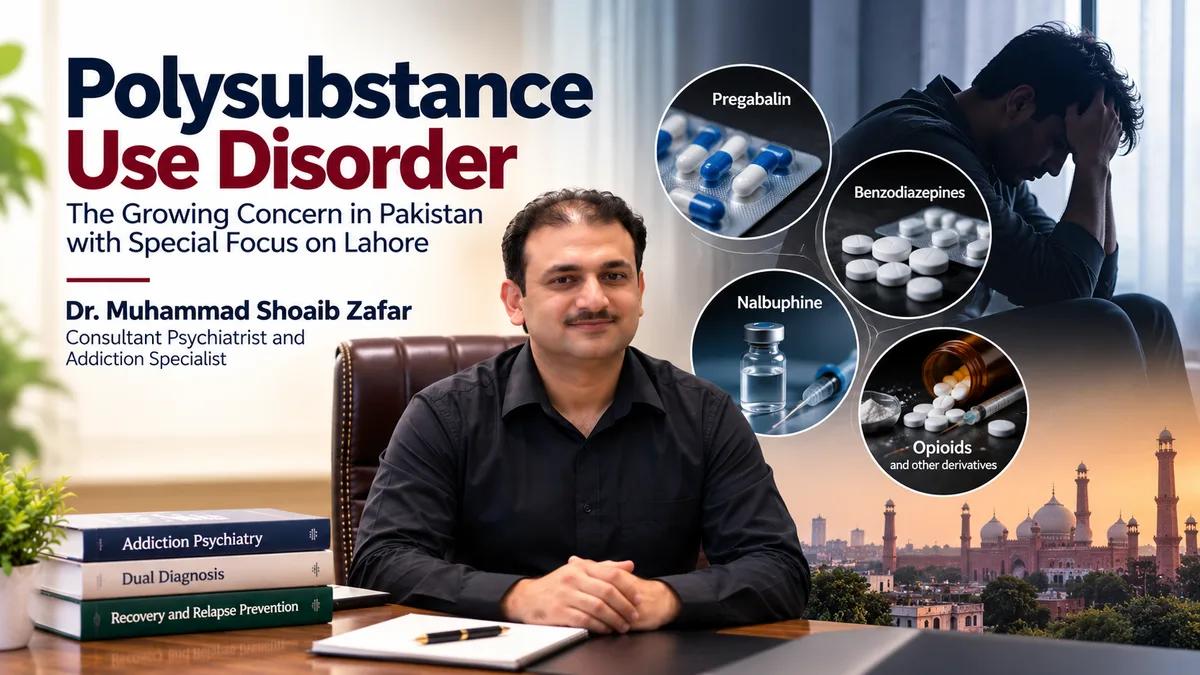
Polysubstance Use Disorder in Pakistan: The Growing Concern About Pregabalin, Benzodiazepines and Opioids in Lahore
Author: Dr. Muhammad Shoaib Zafar Consultant Psychiatrist & Addiction Specialist | Lahore, Pakistan
Polysubstance use is becoming an important clinical challenge in addiction psychiatry. Increasingly, patients do not present with dependence on just one substance.
Instead, they may be using several medicines or drugs together to manage anxiety, improve sleep, relieve pain, experience intoxication or cope with emotional distress.
In Pakistan, concerns about the non-medical use of prescription medicines—including pregabalin, benzodiazepines, opioid painkillers and injectable preparations such as nalbuphine—deserve greater attention.
In Lahore, psychiatrists and addiction treatment professionals need to remain alert to these patterns, particularly when evaluating young adults and patients presenting with unexplained sedation, withdrawal symptoms or repeated requests for medication.
However, the scale of this problem should be interpreted carefully: reliable, recent population-level data specifically measuring polysubstance use in Lahore remain limited.
What is polysubstance use disorder?
Polysubstance use describes the use of multiple psychoactive substances, either simultaneously or across different periods. When a person develops clinically significant problems involving several substances, they may meet the criteria for one or more substance use disorders.
For example, someone might take pregabalin for its calming effects, use alprazolam or another benzodiazepine to sleep, and misuse an opioid painkiller for intoxication.
Another person may combine heroin or other opioids with sedatives to intensify their effects.
The clinical risks depend on the substances involved, their doses, the pattern of use and the individual’s physical and mental health.
Importantly, taking several prescribed medicines does not automatically mean a person has an addiction. A diagnosis requires a proper assessment of impaired control, continued use despite harm, craving, functional impairment and other relevant clinical features.
What do national and international statistics tell us?
Drug use in Pakistan
The national survey Drug Use in Pakistan 2013, conducted with support from the United Nations Office on Drugs and Crime (UNODC), estimated that approximately 6.7 million people aged 15–64 had used substances other than alcohol and tobacco during the preceding year.
The survey estimated that approximately 1.6 million people had misused prescription opioids and 1.5 million had misused tranquilisers or sedatives for non-medical purposes.
These findings established prescription medicine misuse as an important component of Pakistan’s drug-related health burden.
These are historical estimates, not current prevalence figures. A new National Drug Use Survey for Pakistan 2022–24 was launched in October 2022, but I could not verify a newer published national prevalence estimate that supersedes the older figures for this article.
The international picture
The UNODC World Drug Report 2025 estimated that approximately 316 million people used drugs worldwide in 2023, excluding alcohol and tobacco. An estimated 61 million people used opioids during that year.
These figures illustrate the scale of the global drug-use challenge, although they do not measure polysubstance use specifically.
A 2025 study published in PLOS Global Public Health, analysing 130,859 drug-screening tests conducted in Pakistan between 2008 and 2022, found that 6,270 specimens—4.8%—were positive for at least one substance included in the screening panel. Benzodiazepines accounted for 13.7% of positive drug findings, and opioids for 16%.
These results are useful indicators of clinical and laboratory patterns, but they are not estimates of national prevalence: most specimens came from Sindh, and the tested population was not representative of the general public.
Together, the available evidence supports the need for better surveillance, prescription monitoring and accessible addiction treatment in Pakistan.
Pregabalin misuse: an emerging clinical concern
Pregabalin is prescribed for certain neuropathic pain conditions, epilepsy and, in some countries, anxiety disorders. Although it has legitimate medical uses, non-medical use can lead to dependence and withdrawal symptoms.
Some individuals misuse pregabalin for its calming or sedating effects, or combine it with other substances to intensify intoxication.
Warning signs may include escalating doses, repeated early requests for prescriptions, use without a clear medical indication, impaired daily functioning and difficulty stopping the medicine.
Pregabalin deserves particular attention when a patient also uses opioids or sedatives.
The combination can increase drowsiness, impair coordination and contribute to respiratory depression, especially in people with other risk factors.
Although clinicians in Pakistan may encounter patients reporting non-medical pregabalin use, reliable population-level evidence quantifying its current prevalence or rate of increase in Lahore is insufficient.
The concern is clinically important, but the size of the local trend requires better data.
Benzodiazepines: dependence hidden behind a prescription
Benzodiazepines, including alprazolam, clonazepam, diazepam and bromazepam, may be prescribed for specific anxiety, seizure or sleep-related indications. Their risks increase when they are taken for prolonged periods without regular clinical review or used outside medical supervision.
Dependence can develop even when use initially begins with a prescription. Some patients continue taking these medicines because they experience rebound anxiety, insomnia or other withdrawal symptoms when they reduce the dose.
Combining benzodiazepines with opioids is particularly dangerous because both can suppress the central nervous system and breathing.
Clinicians should assess the duration of use, dose escalation, concurrent substances and previous withdrawal symptoms. Benzodiazepines should not be stopped abruptly in a person who may be physically dependent, because severe withdrawal, including seizures, can occur. A supervised, individualised taper may be required.
Nalbuphine and other opioid derivatives in Pakistan
Nalbuphine is an opioid analgesic used for pain management in appropriate clinical settings. Its medical use should be distinguished from non-medical use, including unsupervised injections or use for psychoactive effects.
Concerns about the misuse of injectable nalbuphine, tramadol and other opioid painkillers warrant attention from addiction specialists, emergency departments and healthcare regulators.
The risks include opioid-related dependence, impaired consciousness, injection-related complications and potentially dangerous interactions with sedatives.
Tramadol also carries a risk of seizures and serotonin toxicity in certain circumstances, in addition to opioid-related adverse effects.
However, robust contemporary data establishing the prevalence or rate of increase of nalbuphine misuse specifically in Lahore are not available to substantiate a numerical claim.
Reports from clinical practice can identify emerging problems, but systematic surveillance is needed to determine their scale.
Why combining substances is particularly dangerous
Polysubstance use may be more dangerous than the use of an individual substance because different drugs can interact in unpredictable ways.
The combination of opioids with benzodiazepines or pregabalin can increase sedation and suppress breathing.
Alcohol and other sedating medicines may further increase these risks.
Other complications include falls, accidents, memory impairment, worsening depression, financial and family difficulties, and increased risk of overdose. In people who inject drugs, shared or contaminated equipment can also transmit HIV and hepatitis.
Tolerance does not eliminate these risks.
A person who believes they can handle a particular combination may still experience a medical emergency, especially when the dose, drug formulation or purity changes.
If someone is difficult to wake, has slow or irregular breathing, or develops blue or grey lips, treat this as an emergency. Call emergency services immediately, administer naloxone if opioid overdose is suspected and naloxone is available, and follow the emergency operator’s instructions.
Do not leave the person alone.
Treatment of polysubstance use disorder in Lahore
Effective treatment begins with a comprehensive psychiatric and medical assessment. The clinician needs to establish which substances are being used, their frequency, the risk of withdrawal, coexisting psychiatric disorders and any immediate medical complications.
Treatment may include:
* Medically supervised withdrawal management: Particularly important when opioid or sedative dependence is present. * Evidence-based addiction treatment: Opioid use disorder may benefit from appropriate medication treatment, including buprenorphine or methadone where available and clinically indicated. * Psychological interventions: Motivational interviewing, cognitive behavioural therapy and relapse-prevention work can help patients understand triggers and develop healthier coping strategies.
* Treatment of coexisting conditions: Depression, anxiety, trauma, chronic pain and sleep disorders should be addressed without inadvertently reinforcing harmful medication use. * Family involvement and continuing care: With the patient’s consent, family education, structured rehabilitation and follow-up can support recovery and reduce relapse risk.
Treatment should be individualised. Detoxification alone is rarely sufficient to address the psychological, social and behavioural factors that maintain substance use disorders.
A call for greater awareness in Lahore
Polysubstance use is not simply a problem of willpower. It is a complex health condition that can involve dependence, psychological distress, social vulnerability and the non-medical use of otherwise legitimate medicines.
Pakistan needs updated population surveys, stronger prescription monitoring, improved access to addiction services and better training for healthcare professionals. Lahore also needs reliable local data to distinguish isolated clinical reports from genuine changes in community-level patterns.
For families, the most important step is to seek professional help early rather than waiting for an overdose, severe withdrawal or major disruption to daily life.
Recovery is possible. With appropriate medical care, psychological treatment and continuing support, people experiencing polysubstance use disorder can work towards safer, more stable and healthier lives.
About the author
Dr. Muhammad Shoaib Zafar is a Consultant Psychiatrist and Addiction Specialist based in Lahore, Pakistan. His clinical interests include addiction psychiatry, medically supervised detoxification, opioid-related disorders, dual diagnosis and relapse prevention.
Medical disclaimer: This article is intended for education and awareness. It does not replace an individual medical assessment. Do not abruptly discontinue benzodiazepines or other dependence-forming medicines without professional guidance.
References
1. United Nations Office on Drugs and Crime (UNODC). Drug Use in Pakistan 2013. https://www.unodc.org/copak/uploads/documents/Publications/SurveyReportFinal_2013.pdf
2. United Nations in Pakistan. National Drug Use Survey Pakistan 2022–24, Launched. 26 October 2022. https://pakistan.un.org/en/204917-media-update-united-nations-pakistan-26-october-2022 3. UNODC. World Drug Report 2025: Special Points. https://www.unodc.org/documents/data-and-analysis/WDR2025/WDR25SpecialPoints_web.pdf 4. Sarfaraz Y, Jafri L, Majid H, et al.
Exploring landscape of drug abuse trends in Pakistan: A decade and a half of clinical laboratory big data analysis. PLOS Global Public Health. 2025;5(5):e0004424. https://doi.org/10.1371/journal.pgph.0004424 5. Prescription drug dependence with and without concurrent illicit drug use: A multicenter cross-sectional survey among an addiction treatment-seeking population.
Frontiers in Psychiatry. 2023. https://doi.org/10.3389/fpsyt.2023.1133606
Frequently Asked Questions
Does taking several prescribed medicines mean someone has an addiction?
No. Taking multiple prescribed medicines does not automatically mean addiction. Diagnosis requires a clinical assessment of factors such as impaired control, craving, continued use despite harm and difficulties with daily functioning.
Why is combining opioids with pregabalin or benzodiazepines dangerous?
These combinations can increase sedation and suppress breathing. Alcohol and other sedating medicines may further increase the risks, and tolerance does not eliminate the danger.
What should I do if I suspect an overdose?
If someone is difficult to wake, has slow or irregular breathing, or develops blue or grey lips, call emergency services immediately. Give naloxone if opioid overdose is suspected and it is available, follow the emergency operator’s instructions and do not leave the person alone.
How is polysubstance use treated?
Treatment starts with a psychiatric and medical assessment. It may include supervised withdrawal management, appropriate medication, psychological therapies, care for coexisting conditions and ongoing support. Treatment is individualised; detoxification alone is rarely sufficient. Benzodiazepines should not be stopped abruptly if physical dependence may be present.
About the author
Consultant Psychiatrist and Addiction Specialist
MBBS — University of Health Sciences (UHS); MD Psychiatry — King Edward Medical University (KEMU); MPH — Institute of Public Health (IPH); UNODC Certified Addiction Specialist; International Certification of Addiction Professionals (ICAP-P); Formal training/fellowship in Child & Adolescent Psychiatry — King Edward Medical University, Lahore
King Edward Medical University (KEMU) & Mayo Hospital, Lahore
clinical interests
Adult Psychiatry; Addiction Psychiatry & Rehabilitation; Child & Adolescent Psychiatry; Psychotherapy & Psychological Interventions; Psychiatric Assessment & Consultation
training
Formal training/fellowship in Child & Adolescent Psychiatry, King Edward Medical University, Lahore
memberships
Pakistan Medical & Dental Council (PMDC); Pakistan Psychiatric Society (PPS); International Certification of Addiction Professionals (ICAP)
Dr. Muhammad Shoaib Zafar, MBBS, MD (Psychiatry) Assistant Professor of Psychiatry, King Edward Medical University (KEMU), Lahore