Written by
Consultant Psychiatrist and Addiction Specialist
MBBS — University of Health Sciences (UHS); MD Psychiatry — King Edward Medical University (KEMU); MPH — Institute of Public Health (IPH); UNODC Certified Addiction Specialist; International Certification of Addiction Professionals (ICAP-P); Formal training/fellowship in Child & Adolescent Psychiatry — King Edward Medical University, Lahore
View profileApproved by
Dr. Muhammad Shoaib Zafar
Super Admin
- Published:
- Last updated:
- Approved:
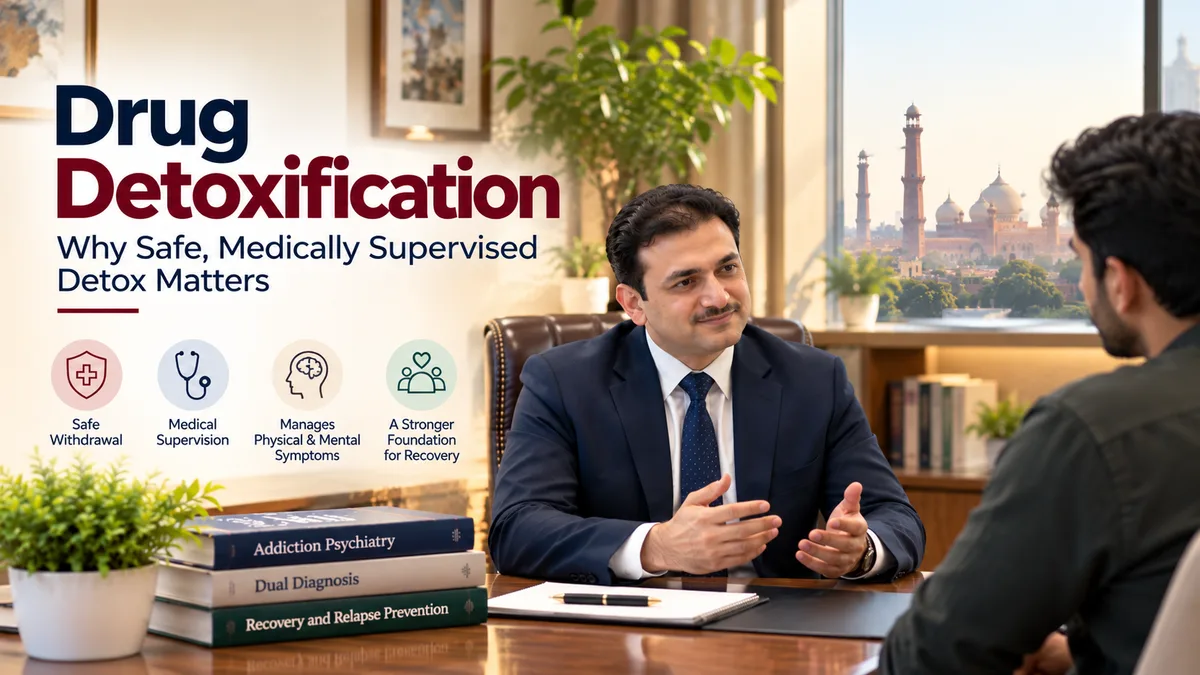
Drug Detoxification in Lahore: Why Safe, Medically Supervised Withdrawal Matters
Author: Dr. Muhammad Shoaib Zafar Consultant Psychiatrist & Addiction Specialist | Lahore, Pakistan
When a person decides to stop using drugs, alcohol or dependence-forming medicines, families often expect recovery to begin immediately. They may ask the patient to stop everything at home, arrange a few days of rest or believe that willpower alone is enough.
Unfortunately, stopping a substance after prolonged use can be medically complicated. Some people experience anxiety, insomnia, sweating and intense cravings, while others develop seizures, severe confusion, dehydration or potentially life-threatening withdrawal complications.
Drug detoxification is not simply stopping drugs. It is a medical process that helps a person withdraw from substances as safely as possible and prepares them for continuing addiction treatment.
For families seeking drug detoxification in Lahore, understanding when medical supervision is necessary can help prevent avoidable complications and improve the chances of sustained recovery.
What is drug detoxification?
Detoxification, or medically supervised withdrawal management, is the process of helping the body adjust when a person reduces or stops a substance on which they have developed physical dependence.
Depending on the substance, treatment may involve clinical observation, medicines, hydration, nutritional support, management of sleep disturbances and monitoring for complications.
Detoxification may be required for alcohol, opioids, benzodiazepines, pregabalin and other substances associated with dependence. The appropriate approach differs considerably between them.
It is important to understand that detoxification is the beginning of addiction treatment, not the complete treatment itself. It addresses the immediate effects of withdrawal but does not, by itself, resolve cravings, psychological distress, family problems or the behavioural patterns that can contribute to relapse.
What do national and international statistics tell us?
Pakistan continues to face a substantial challenge in providing accessible addiction treatment.
The United Nations Office on Drugs and Crime (UNODC) Drug Use in Pakistan 2013 survey estimated that approximately 6.7 million people aged 15–64 had used drugs during the preceding year. Around 4.25 million were estimated to have drug use disorders or dependence requiring intervention.
The report also estimated that approximately 20% of people who used drugs had used more than one controlled or illicit substance during the previous year. This is particularly relevant because withdrawal management becomes more complicated when several substances are involved.
These figures are historical estimates, not current prevalence data. Pakistan launched a subsequent national drug-use survey in 2022, but a newer published national prevalence estimate was not verified for this article.
Internationally, the United Nations Office on Drugs and Crime’s World Drug Report 2025 estimated that approximately 316 million people used drugs worldwide in 2023, excluding alcohol and tobacco.
These statistics describe the scale of substance use, rather than the number of people who need detoxification. Nevertheless, they highlight why safe withdrawal management and accessible continuing treatment remain important public health priorities.
Why is detoxification important?
1. It helps prevent dangerous withdrawal complications
When the brain and body adapt to repeated substance exposure, sudden cessation can disrupt normal physiological functioning.
Alcohol withdrawal can progress from tremors, sweating and anxiety to seizures or delirium. Withdrawal from benzodiazepines can also cause seizures and severe confusion, particularly after prolonged use or abrupt discontinuation.
Opioid withdrawal is usually not life-threatening in otherwise healthy adults, but vomiting, diarrhoea, dehydration and other complications can become serious. People with medical illnesses or concurrent substance use may face additional risks.
A medically supervised detoxification programme helps identify these risks early and provides appropriate treatment.
2. It addresses more than physical symptoms
Withdrawal may involve intense anxiety, irritability, low mood, insomnia and cravings. These symptoms can be distressing and may contribute to early treatment dropout.
Appropriate clinical care can help patients manage discomfort, understand what to expect and remain engaged in treatment.
3. It provides an opportunity to identify other health problems
People entering addiction treatment may also have depression, bipolar disorder, psychosis, anxiety disorders, liver disease, nutritional deficiencies or other medical conditions.
A psychiatric and medical assessment helps identify these problems and guides the next stage of care.
4. It creates a foundation for recovery
Once withdrawal symptoms are stabilised, patients can begin addressing the factors that maintain substance use.
These may include psychological distress, social pressures, family conflict, chronic pain or an untreated psychiatric disorder.
The objective is not simply to complete detoxification. It is to help the person move towards a sustainable recovery plan.
Why does detoxification take time?
One of the most common questions families ask is: Why can detoxification not be completed in just two or three days?
The answer depends on the substance, the duration and amount of use, the person’s physical health, previous withdrawal experiences and whether multiple substances are involved.
There is no single detoxification duration that is appropriate for everyone.
Alcohol
Withdrawal symptoms can begin within 6–24 hours after a substantial reduction or cessation of drinking.
Seizures may occur during the early withdrawal period, while delirium can develop later, often around 48–96 hours after the last drink.
A patient who initially appears stable may therefore still require monitoring. Severe withdrawal can need hospital-level care.
Opioids
Withdrawal from short-acting opioids often begins within hours of the last use and may continue for several days.
Withdrawal from longer-acting opioids can follow a different timeline.
Even after the acute physical symptoms improve, cravings and psychological difficulties may persist. Appropriate medication treatment can help some patients manage withdrawal and reduce the risk of returning to opioid use.
Benzodiazepines and other sedatives
Withdrawal from benzodiazepines can be particularly challenging after prolonged use.
Depending on the medication, dose and duration, symptoms may begin later and continue for an extended period.
Abrupt cessation can cause seizures and other serious complications. Some patients require a gradual, individualised reduction under medical supervision rather than a rapid detoxification schedule.
Polysubstance use
When a person has been using several substances, the withdrawal pattern may be less predictable.
The effects of one substance can conceal the symptoms of another, and medicines used during treatment may interact.
A qualified clinician must therefore determine the appropriate duration and level of monitoring for each patient.
Why may inpatient detoxification be necessary?
For patients at significant risk of complicated withdrawal, an inpatient setting offers advantages that are difficult to reproduce at home.
Continuous clinical observation: Trained staff can monitor vital signs, hydration, consciousness, behaviour and emerging withdrawal symptoms.
Access to medical intervention: If a patient develops a seizure, severe agitation, delirium or another complication, urgent treatment can be initiated and escalation to hospital or intensive care arranged when required.
Safer medication management: Withdrawal medicines must be selected and adjusted according to the substance involved, symptom severity and individual risk. Excessive sedation and interactions are important concerns, particularly in polysubstance use.
Psychiatric assessment and support: Depression, psychosis, severe anxiety and suicidal thoughts may complicate withdrawal.
A psychiatrist can assess these symptoms and coordinate treatment.
A structured treatment environment: Removing immediate access to substances and providing consistent care may help patients who have repeatedly struggled to stop using drugs at home.
The American Society of Addiction Medicine’s alcohol-withdrawal guideline recommends close monitoring for patients with significant withdrawal symptoms and higher-risk presentations.
UNODC and WHO international treatment standards likewise emphasise evidence-based withdrawal management, with medication and psychosocial support where indicated.
However, inpatient treatment is not necessary for every person with a substance use disorder. Patients with mild withdrawal and low complication risk may be suitable for appropriately organised outpatient care.
The decision should follow an individual medical and psychiatric assessment.
For severe alcohol or sedative withdrawal, suspected overdose, seizures, delirium or unstable medical conditions, an acute hospital setting may be required rather than a routine rehabilitation facility.
Why should a qualified psychiatrist supervise addiction detoxification?
Addiction is not solely a physical condition. It can involve changes in mood, thinking, sleep, behaviour and decision-making, often alongside other psychiatric disorders.
A psychiatrist with addiction-treatment expertise can assess the substance-use history, identify co-occurring mental health conditions, evaluate withdrawal risks and develop an appropriate treatment plan.
This is especially important when patients use multiple substances, have a history of seizures or severe withdrawal, or present with depression, psychosis or suicidal thoughts.
Medical supervision also helps avoid common mistakes, such as abruptly stopping dependence-forming medicines, using inappropriate sedatives or assuming that every symptom is caused by withdrawal.
The treating team should be appropriately trained, have access to essential monitoring and emergency arrangements, and refer patients to a higher level of care when necessary.
What happens after detoxification?
Successful detoxification should be followed by a continuing treatment plan.
Depending on the patient’s needs, this may include:
* Medication treatment for opioid use disorder or other appropriate conditions.
* Psychological interventions, including motivational interviewing and cognitive behavioural therapy. * Treatment of co-occurring psychiatric disorders. * Family education and structured support, with the patient’s consent. * Relapse-prevention planning, follow-up appointments and rehabilitation where indicated.
Tolerance to opioids can fall after a period of abstinence.
Returning to a previously tolerated dose may therefore cause a fatal overdose. Patients and families should receive appropriate education about overdose prevention and naloxone where available and indicated.
Drug detoxification in Lahore: choosing safe treatment
Families looking for a drug detoxification centre in Lahore should ask whether the service provides a proper medical assessment, supervision by qualified clinicians, evidence-based withdrawal protocols, emergency referral arrangements and a continuing treatment plan.
A clean building or a fixed-duration programme alone does not establish clinical quality. The important questions are whether the treatment matches the patient’s needs, whether complications can be recognised promptly, and whether care continues after withdrawal stabilisation.
At Revive Sobriety Center and other addiction services, families should seek clear information about the clinical team, the level of medical supervision available and the arrangements for managing emergencies.
Patients with severe or complicated withdrawal may need hospital-based care.
Conclusion: Detoxification is the first step, not the finish line
Addiction recovery requires more than stopping a substance. It begins with understanding the person’s medical and psychiatric needs, managing withdrawal safely and building a plan for ongoing treatment.
The right duration and setting depend on individual risk.
For patients with significant withdrawal risks, inpatient detoxification under qualified medical and psychiatric supervision can help prevent serious complications and support a safer transition into recovery.
For families in Lahore, the most important step is to seek professional assessment rather than attempting potentially dangerous withdrawal at home.
Safe detoxification can open the door to recovery. Continuing treatment helps keep that door open.
About the author
Dr. Muhammad Shoaib Zafar is a Consultant Psychiatrist and Addiction Specialist based in Lahore, Pakistan. His clinical interests include addiction psychiatry, medically supervised detoxification, opioid-related disorders, dual diagnosis and relapse prevention.
Medical disclaimer: This article is for educational purposes and does not replace a personal medical assessment. Do not abruptly stop alcohol, benzodiazepines or other dependence-forming medicines without professional guidance.
References
1. United Nations Office on Drugs and Crime (UNODC). Drug Use in Pakistan 2013. https://www.unodc.org/documents/pakistan/SurveyReportFinal_2013.pdf
2. UNODC. World Drug Report 2025. https://www.unodc.org/unodc/en/data-and-analysis/world-drug-report-2025.html 3. UNODC and World Health Organization. International Standards for the Treatment of Drug Use Disorders: Revised Edition Incorporating Results of Field-Testing. 2020. https://www.unodc.org/documents/drug-prevention-and-treatment/UNODC-WHOInternationalStandardsTreatmentDrugUseDisordersApril2020.pdf
4. American Society of Addiction Medicine (ASAM). The ASAM Clinical Practice Guideline on Alcohol Withdrawal Management. 2020. https://www.asam.org/quality-care/clinical-guidelines/alcohol-withdrawal-management-guideline 5. Management of alcohol withdrawal syndromes in general hospital settings. BMJ. 2025. https://www.bmj.com/content/388/bmj-2024-080461
6. British Association for Psychopharmacology. Evidence-based consensus guidelines for the pharmacological management of substance dependence. 2026. https://pubmed.ncbi.nlm.nih.gov/41731947/
Frequently Asked Questions
How long does drug detoxification take?
There is no single timeline. Duration depends on the substance, amount and length of use, physical health, previous withdrawal experiences and use of multiple substances. Some medicines, such as benzodiazepines, may require a gradual, medically supervised reduction.
Does everyone need inpatient detoxification?
No. People with mild withdrawal and a low risk of complications may be suitable for organised outpatient care after assessment. Those at higher risk may need inpatient monitoring, while severe withdrawal, seizures or delirium may require an acute hospital.
Is detoxification enough to treat addiction?
Detoxification manages withdrawal but is only the beginning of treatment. Continuing care may include medication, psychological therapy, treatment of mental health conditions, family support with the patient's consent, and relapse-prevention planning.
What should families look for in a detoxification service in Lahore?
Ask about medical assessment, qualified clinical supervision, evidence-based withdrawal protocols, emergency referral arrangements and continuing treatment. A fixed-duration programme or a clean building alone does not establish clinical quality.
About the author
Consultant Psychiatrist and Addiction Specialist
MBBS — University of Health Sciences (UHS); MD Psychiatry — King Edward Medical University (KEMU); MPH — Institute of Public Health (IPH); UNODC Certified Addiction Specialist; International Certification of Addiction Professionals (ICAP-P); Formal training/fellowship in Child & Adolescent Psychiatry — King Edward Medical University, Lahore
King Edward Medical University (KEMU) & Mayo Hospital, Lahore
clinical interests
Adult Psychiatry; Addiction Psychiatry & Rehabilitation; Child & Adolescent Psychiatry; Psychotherapy & Psychological Interventions; Psychiatric Assessment & Consultation
training
Formal training/fellowship in Child & Adolescent Psychiatry, King Edward Medical University, Lahore
memberships
Pakistan Medical & Dental Council (PMDC); Pakistan Psychiatric Society (PPS); International Certification of Addiction Professionals (ICAP)
Dr. Muhammad Shoaib Zafar, MBBS, MD (Psychiatry) Assistant Professor of Psychiatry, King Edward Medical University (KEMU), Lahore