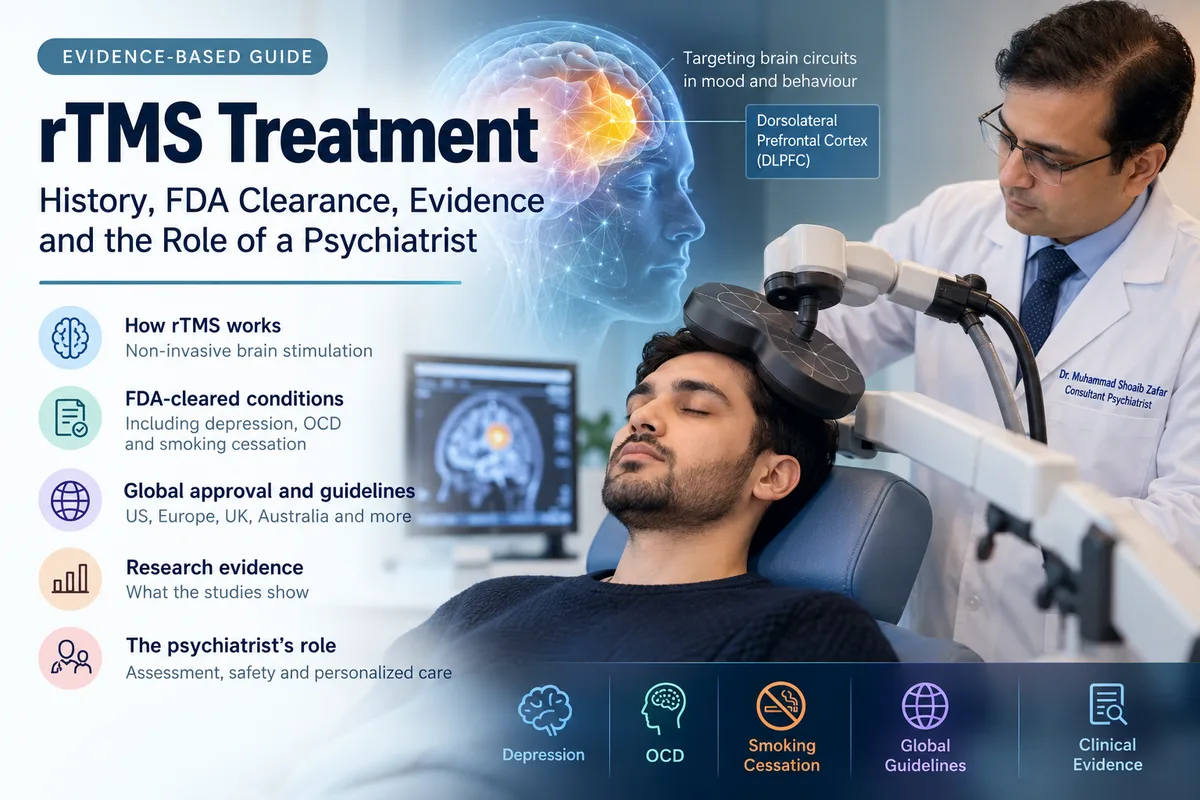
Written by
Consultant Psychiatrist and Addiction Specialist
MBBS — University of Health Sciences (UHS); MD Psychiatry — King Edward Medical University (KEMU); MPH — Institute of Public Health (IPH); UNODC Certified Addiction Specialist; International Certification of Addiction Professionals (ICAP-P); Formal training/fellowship in Child & Adolescent Psychiatry — King Edward Medical University, Lahore
View profile
When Should You See a Psychiatrist? 10 Warning Signs You Shouldn’t Ignore
Everyone experiences stress, sadness, worry or emotional ups and downs. Difficult periods are a normal part of life.
But sometimes changes in mood, thoughts, behaviour or functioning become persistent, severe or difficult to control. When this happens, it may be time to speak with a mental health professional.
A psychiatrist is a medical doctor who specializes in diagnosing and treating mental health conditions. Psychiatrists can assess psychological symptoms as well as possible medical, neurological, medication-related or substance-related factors that may be contributing to them.
The difficult question for many people is:
“How do I know whether what I am experiencing is something I should handle myself—or whether I need to see a psychiatrist?”
There is no single symptom that answers this question. However, certain warning signs should encourage you to seek professional assessment.
⸻
10 Signs You May Need to See a Psychiatrist
1. Your mood has changed significantly or remains low
Feeling sad after a loss, disappointment or stressful event is normal.
However, persistent sadness, emptiness, hopelessness, irritability or loss of interest in previously enjoyable activities may indicate depression or another mental health condition.
You should consider professional assessment if you notice:
* Persistent sadness or low mood * Loss of interest or pleasure * Hopelessness * Excessive guilt * Irritability * Low motivation * Difficulty concentrating * Significant changes in sleep or appetite * Feeling that life has lost its meaning
Depression does not always look like sadness. Some people primarily experience irritability, exhaustion, physical complaints or withdrawal from others.
⸻
2. Anxiety or worry is interfering with your life
Everyone worries occasionally.
The concern becomes more significant when anxiety is excessive, persistent or difficult to control and begins affecting your work, studies, relationships, sleep or daily activities.
You may benefit from psychiatric assessment if you experience:
* Constant worrying * Racing thoughts * Restlessness * Irritability * Difficulty concentrating * Muscle tension * Sleep disturbance * Fear of particular situations * Avoidance of places or activities * Repeated panic attacks
Anxiety disorders can include generalized anxiety disorder, panic disorder, social anxiety disorder, phobias and other conditions.
You do not have to wait until anxiety becomes unbearable before seeking help.
⸻
3. You are having panic attacks
A panic attack can feel frightening and may cause:
* Sudden intense fear * Rapid heartbeat * Chest discomfort * Shortness of breath * Trembling * Sweating * Dizziness * Feeling detached or unreal * Fear of losing control * Fear of dying
Because these symptoms can resemble physical illness, particularly for a first episode, medical assessment may sometimes be appropriate.
If panic attacks are recurring or you have started avoiding places because you are afraid of having another attack, professional help can make a major difference.
⸻
4. Your sleep has changed significantly
Sleep and mental health are closely connected.
Persistent insomnia, sleeping excessively, waking repeatedly during the night, or experiencing a major reduction in the need for sleep can sometimes be associated with psychiatric conditions.
Pay particular attention when sleep changes occur alongside:
* Depression * Anxiety * Irritability * Racing thoughts * Mood swings * Increased energy * Changes in behaviour * Poor concentration
For example, needing very little sleep while simultaneously experiencing unusually high energy, rapid speech, impulsive behaviour or an elevated/irritable mood warrants professional evaluation.
Sleep problems can also have medical causes, so a proper assessment is important.
⸻
5. Your thoughts or behaviour feel out of your control
Sometimes people notice changes in themselves that they cannot explain.
You may find yourself:
* Repeating behaviours despite wanting to stop * Experiencing intrusive thoughts * Checking things repeatedly * Developing unusual fears * Becoming increasingly suspicious * Acting impulsively * Engaging in risky behaviour * Experiencing extreme mood changes
These symptoms can occur in several psychiatric conditions, including obsessive-compulsive disorder, mood disorders, psychotic disorders, impulse-control problems and others.
You do not need to diagnose yourself before seeing a psychiatrist.
The purpose of psychiatric assessment is precisely to understand what is happening and determine what, if anything, requires treatment.
⸻
6. You are hearing, seeing or experiencing things others don’t
Hearing voices, seeing things others cannot see, experiencing unusual beliefs, or becoming extremely suspicious can be signs of a serious mental health condition.
Examples may include:
* Hearing voices when nobody is present * Believing someone is deliberately monitoring or persecuting you despite lack of evidence * Feeling that ordinary events contain special personal messages * Becoming increasingly disconnected from reality * Experiencing severe confusion or disorganized behaviour
These symptoms require prompt professional assessment.
They can occur in conditions such as psychotic disorders, severe mood disorders, substance-related conditions and some medical or neurological illnesses.
Early assessment and treatment can be particularly important.
⸻
7. Your relationships, work or studies are deteriorating
One of the most useful questions in mental health is:
“How much is this affecting my life?”
A person may have significant psychological symptoms even when they continue to function at work.
On the other hand, noticeable deterioration may be an important warning sign.
Consider seeking help if you are:
* Frequently missing work or school * Unable to concentrate * Withdrawing from family and friends * Having repeated conflicts * Losing interest in responsibilities * Unable to perform at your previous level * Struggling to manage everyday tasks
Mental health problems often become easier to treat when addressed before functioning deteriorates severely.
⸻
8. You are using alcohol, drugs or medications to cope
Using substances to manage stress, anxiety, sleep, emotional pain or difficult thoughts can gradually become a serious problem.
Warning signs include:
* Needing increasing amounts * Using substances more frequently * Unable to stop despite wanting to * Craving the substance * Neglecting responsibilities * Continuing despite relationship or health problems * Experiencing withdrawal symptoms * Repeated relapse after attempts to stop
Addiction and mental health conditions frequently occur together.
This is sometimes referred to as dual diagnosis or co-occurring disorders.
In such cases, treating only the substance use or only the psychiatric symptoms may not be enough. An integrated assessment and treatment plan may be required.
⸻
9. You are experiencing thoughts of death, self-harm or suicide
This is one of the most important reasons to seek help.
Thoughts such as:
* “I don’t want to live anymore.” * “Everyone would be better without me.” * “I wish I could disappear.” * Thinking about harming yourself * Thinking about suicide * Making preparations or plans
should never be dismissed as attention-seeking or simply a phase.
If you or someone close to you is at immediate risk of suicide or self-harm, seek emergency medical help or go to the nearest emergency department rather than waiting for a routine appointment.
You do not have to face these thoughts alone.
⸻
10. Your family or people close to you have noticed a major change
Sometimes the person experiencing psychological difficulties does not recognize how much they have changed.
Family members may notice:
* Increased isolation * Unusual anger * Major personality changes * Neglect of personal care * Suspiciousness * Significant changes in sleep * Sudden deterioration in work or studies * Unusual spending or risky behaviour * Substance use * Emotional instability
If several people who know you well are concerned about significant changes in your behaviour, it may be worth taking their concerns seriously.
A psychiatric evaluation does not mean that you definitely have a mental illness.
It means something has changed enough to deserve professional attention.
⸻
Psychiatrist or Psychologist: Who Should You See?
This is one of the most common questions patients ask.
A psychiatrist is a medical doctor specializing in mental health. A psychiatrist can assess mental disorders, consider medical and substance-related causes, prescribe medication when appropriate, and provide or coordinate psychological treatments.
A psychologist is trained primarily in psychological assessment and psychotherapy.
A therapist/counsellor may provide talking therapies and behavioural support depending on their professional training and scope of practice.
The choice depends on the person’s symptoms and needs.
Sometimes the most effective approach involves both psychiatric and psychological care.
⸻
Do You Need a Psychiatrist If You Are “Still Functioning”?
Yes, potentially.
You don’t have to lose your job, stop studying or become severely unwell before seeking psychiatric help.
Many people with depression, anxiety, ADHD, OCD, bipolar disorder and other conditions continue to function outwardly while experiencing substantial internal distress.
A useful question is not simply:
“Am I functioning?”
but:
“How much effort is it taking me to function, and how much is my mental health affecting my quality of life?”
Early professional assessment can help identify problems before they become more severe.
⸻
What Happens During a Psychiatric Consultation?
Many people avoid psychiatrists because they don’t know what will happen during the appointment.
A psychiatric consultation usually involves a detailed discussion about:
* Your current symptoms * When they started * Their severity and frequency * Sleep and appetite * Mood and anxiety * Thoughts and behaviour * Work, education and relationships * Medical history * Current medications * Alcohol or substance use * Previous psychiatric treatment * Family history * Relevant psychological and social factors
Depending on the situation, the psychiatrist may recommend additional medical investigations or assessments.
The purpose is not simply to give a diagnosis.
It is to understand the whole person and the factors affecting their mental health.
⸻
Does Seeing a Psychiatrist Mean You Will Have to Take Medication?
No.
Medication is only one component of psychiatric treatment.
Depending on the diagnosis and individual circumstances, treatment may include:
* Psychoeducation * Psychotherapy * Behavioural interventions * Lifestyle changes * Sleep interventions * Family interventions * Medication * Addiction treatment * A combination of approaches
Medication should be considered based on clinical need, potential benefits, risks and the individual’s preferences and circumstances.
⸻
Don’t Wait Until a Crisis
One of the biggest misconceptions about psychiatric care is that you should seek help only when symptoms become severe.
In reality, seeking professional advice earlier can be useful when symptoms are persistent, worsening or interfering with your life.
You don’t need to know exactly what is wrong before making an appointment.
You only need to recognize that something isn’t right and you would like help understanding it.
⸻
When Is Psychiatric Help Urgent?
Seek urgent medical or emergency help if someone is:
* At immediate risk of suicide or self-harm * Threatening serious harm to another person * Experiencing severe hallucinations or delusions * Extremely confused or disconnected from reality * Severely agitated or uncontrollable * Experiencing a serious medical or substance-related crisis
In an emergency, contact your local emergency service or proceed to the nearest emergency department.
⸻
Take the First Step
Mental health problems are medical conditions, not personal failures.
Whether you are experiencing persistent anxiety, depression, panic attacks, obsessive thoughts, mood changes, addiction, sleep problems or unexplained changes in behaviour, a professional assessment can provide clarity.
You don’t have to wait until your symptoms become unbearable.
If something has changed in the way you think, feel, sleep, behave or function, it may be time to talk to a psychiatrist.
Dr. Muhammad Shoaib Zafar provides psychiatric assessment and treatment for adults, adolescents and families, with clinical expertise spanning psychiatry, addiction, child and adolescent mental health and psychotherapy.
Book a psychiatric consultation to discuss your symptoms and explore an appropriate treatment plan.
Frequently Asked Questions
What are the signs that you need a psychiatrist?
Persistent depression, severe anxiety, panic attacks, major sleep changes, unusual thoughts or perceptions, significant mood changes, addiction, deterioration in functioning, or thoughts of self-harm are among the reasons to consider psychiatric assessment.
When should I see a psychiatrist for anxiety?
Consider professional help when anxiety is persistent, difficult to control, causes significant distress, disrupts sleep or interferes with work, relationships or daily life.
About the author
Consultant Psychiatrist and Addiction Specialist
MBBS — University of Health Sciences (UHS); MD Psychiatry — King Edward Medical University (KEMU); MPH — Institute of Public Health (IPH); UNODC Certified Addiction Specialist; International Certification of Addiction Professionals (ICAP-P); Formal training/fellowship in Child & Adolescent Psychiatry — King Edward Medical University, Lahore
King Edward Medical University (KEMU) & Mayo Hospital, Lahore
clinical interests
Adult Psychiatry; Addiction Psychiatry & Rehabilitation; Child & Adolescent Psychiatry; Psychotherapy & Psychological Interventions; Psychiatric Assessment & Consultation
training
Formal training/fellowship in Child & Adolescent Psychiatry, King Edward Medical University, Lahore
memberships
Pakistan Medical & Dental Council (PMDC); Pakistan Psychiatric Society (PPS); International Certification of Addiction Professionals (ICAP)
Dr. Muhammad Shoaib Zafar, MBBS, MD (Psychiatry) Assistant Professor of Psychiatry, King Edward Medical University (KEMU), Lahore