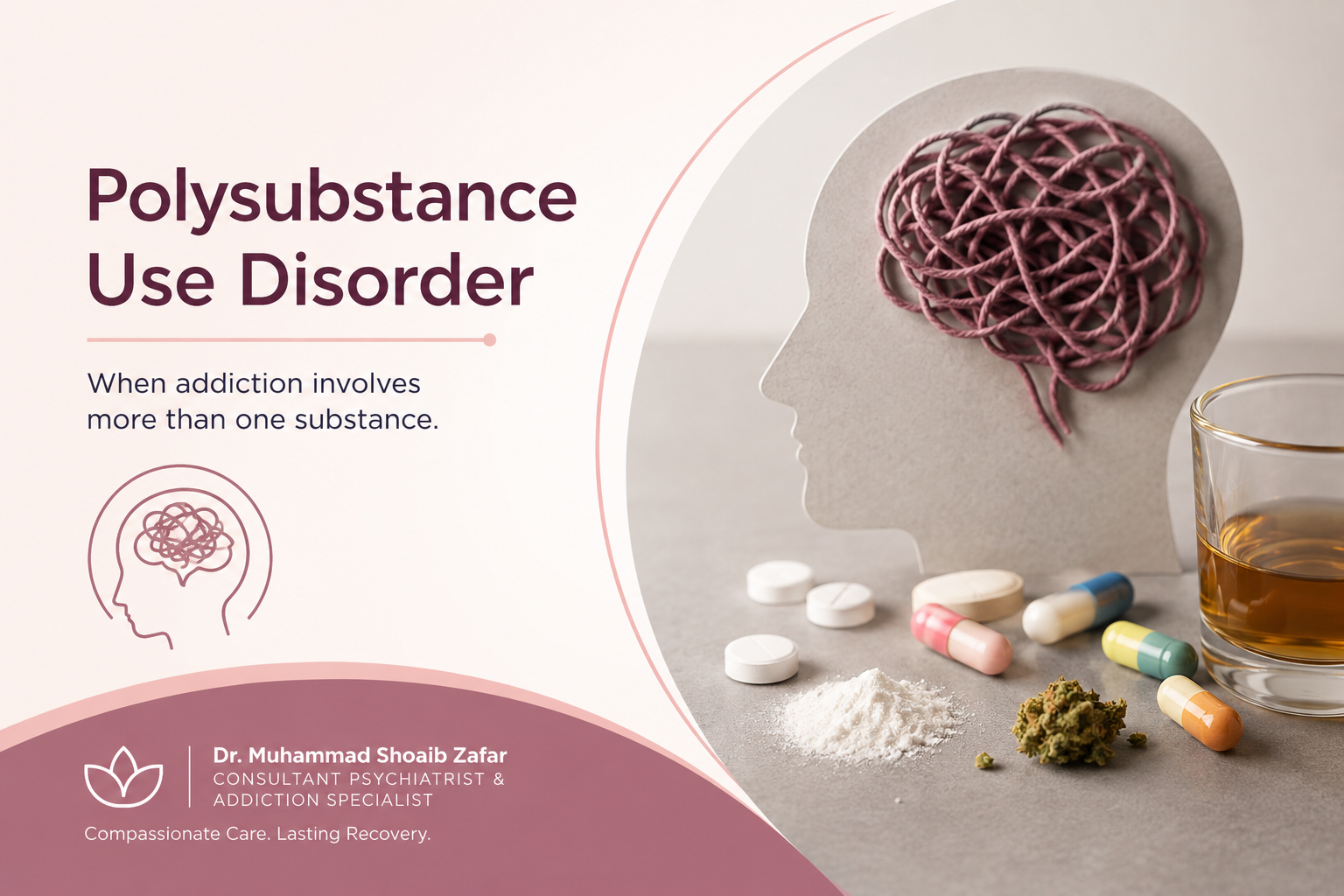
Polysubstance Use Disorder refers to the repeated or simultaneous misuse of two or more psychoactive substances, leading to clinically significant impairment or distress.
These substances may be taken:
* At the same time * Within the same day * Alternately depending on availability * To enhance intoxication * To reduce withdrawal symptoms * To manage emotions or mental illness
The pattern often becomes increasingly complex over time, making diagnosis and treatment more difficult than addiction to a single drug.
⸻
Common Drug Combinations Seen in Pakistan
Although patterns vary between individuals, common combinations include:
* Crystal Meth (Ice) + Heroin * Ice + Cannabis * Heroin + Benzodiazepines * Alcohol + Sleeping Pills * Cocaine + Alcohol * Tramadol + Benzodiazepines * Prescription opioids + Pregabalin * Cannabis + Alcohol * Multiple prescription medications * Nicotine combined with nearly every substance
Some individuals may regularly use four or five different substances simultaneously.
⸻
Why Do People Use Multiple Drugs?
There is rarely a single reason.
Common motivations include:
* Increasing euphoria * Reducing withdrawal symptoms * Self-medicating anxiety or depression * Improving sleep * Increasing energy * Counteracting side effects of another drug * Peer influence * Easy drug availability * Curiosity and experimentation
Over time, the brain adapts to these substances, resulting in dependence on several drugs simultaneously.
⸻
Risk Factors
People at higher risk include:
* Adolescents and young adults * Individuals with depression or anxiety * Patients with ADHD * Trauma survivors * Individuals with personality disorders * Those with chronic pain * Previous addiction history * Family history of substance use disorders * High-stress occupations * Easy access to addictive medications
⸻
Symptoms of Polysubstance Use Disorder
Symptoms vary depending on the substances involved but commonly include:
Physical Symptoms
* Excessive sleepiness * Agitation * Dilated or constricted pupils * Weight loss * Poor hygiene * Tremors * Sweating * Frequent intoxication * Needle marks * Repeated infections
Psychological Symptoms
* Mood swings * Anxiety * Depression * Hallucinations * Suspiciousness * Memory impairment * Poor concentration * Aggressive behaviour * Emotional instability
Behavioural Symptoms
* Secretive behaviour * Financial problems * Relationship conflicts * Loss of employment * Declining academic performance * Legal issues * Repeated unsuccessful attempts to quit * Social isolation
⸻
Why is Polysubstance Use More Dangerous?
Using multiple substances dramatically increases health risks because drugs interact unpredictably.
Possible consequences include:
* Respiratory depression * Heart attack * Stroke * Seizures * Liver failure * Kidney injury * Psychosis * Severe depression * Suicide risk * Accidental overdose * Fatal poisoning
For example:
* Alcohol combined with opioids can suppress breathing. * Cocaine combined with alcohol produces toxic metabolites that increase cardiovascular risk. * Benzodiazepines combined with opioids substantially increase overdose risk. * Ice combined with heroin places tremendous stress on both the cardiovascular and nervous systems.
⸻
Mental Health and Dual Diagnosis
Many patients with polysubstance addiction also suffer from psychiatric illnesses.
These include:
* Depression * Bipolar disorder * Anxiety disorders * PTSD * OCD * ADHD * Personality disorders * Schizophrenia
Treating addiction without addressing underlying psychiatric illness often leads to relapse. Comprehensive treatment should address both conditions simultaneously.
⸻
Diagnosis
Diagnosis requires a detailed evaluation by an addiction psychiatrist.
Assessment generally includes:
* Complete substance use history * Psychiatric assessment * Medical examination * Laboratory investigations * Drug screening * Risk assessment * Family assessment * Motivation for treatment * Previous treatment history
⸻
Treatment of Polysubstance Use Disorder
Treatment should never rely solely on detoxification.
1. Medical Detoxification
The first step is safely managing withdrawal symptoms under medical supervision.
Depending on the substances involved, withdrawal may require:
* Continuous monitoring * Medication-assisted treatment * Hydration * Nutritional support * Sleep management * Emergency care if necessary
Home detox is often unsafe, especially for patients using alcohol, opioids, benzodiazepines, or multiple substances.
⸻
2. Psychiatric Treatment
Underlying mental illnesses should be identified and treated.
Medication may be prescribed for:
* Depression * Anxiety * Bipolar disorder * Psychosis * ADHD * Sleep disorders
Treatment is individualized based on each patient’s diagnosis and needs.
⸻
3. Psychological Therapies
Evidence-based therapies include:
* Cognitive Behaviour Therapy (CBT) * Motivational Interviewing (MI) * Relapse Prevention Therapy * Family Therapy * Contingency Management * Psychoeducation * Mindfulness-based interventions
⸻
4. Inpatient Rehabilitation
Patients with severe addiction often benefit from structured inpatient treatment.
Advantages include:
* Drug-free environment * Medical supervision * Daily psychotherapy * Family counselling * Relapse prevention planning * Peer support * Lifestyle rehabilitation
⸻
5. Long-Term Recovery
Recovery does not end after detoxification.
Successful recovery requires:
* Regular psychiatric follow-up * Therapy sessions * Family involvement * Healthy lifestyle changes * Stress management * Relapse prevention planning * Support groups where appropriate
⸻
Can Polysubstance Use Disorder Be Cured?
Addiction is considered a chronic but treatable medical condition.
Many individuals achieve long-term recovery with appropriate treatment, continued follow-up, and strong family support. Early intervention significantly improves outcomes.
⸻
Prevention
Prevention begins with awareness.
Helpful strategies include:
* Early mental health treatment * Healthy coping skills * Avoiding recreational drug use * Responsible prescribing of medications * Family education * School-based prevention programmes * Community awareness campaigns
⸻
Frequently Asked Questions
Is polysubstance use more dangerous than using one drug?
Yes. Combining multiple substances substantially increases the risk of overdose, psychiatric complications, organ damage, and death.
Can someone recover completely?
Many individuals achieve long-term recovery with comprehensive treatment and continued follow-up.
Is inpatient treatment always necessary?
Not always. The decision depends on the severity of addiction, withdrawal risk, psychiatric illness, medical condition, and social support.
Can mental illness cause polysubstance addiction?
Mental illnesses such as depression, anxiety, bipolar disorder, PTSD, and ADHD may increase vulnerability to substance misuse if left untreated.
⸻
Polysubstance Use Disorder in Pakistan
Pakistan has witnessed increasing misuse of crystal meth (Ice), heroin, pharmaceutical opioids, benzodiazepines, tramadol, pregabalin, cannabis, and alcohol. Many patients present with dependence on multiple substances rather than a single drug.
Delayed treatment often results from stigma, misinformation, fear, or lack of specialized addiction services. Early assessment by a qualified psychiatrist and addiction specialist can reduce complications and improve recovery outcomes.
⸻
Why Choose Specialist Addiction Treatment?
Polysubstance addiction is rarely straightforward. Each patient requires a personalized treatment plan based on the substances used, physical health, psychiatric conditions, family circumstances, and recovery goals.
A multidisciplinary approach involving psychiatrists, psychologists, nursing staff, and family support offers the best chance of sustained recovery.
⸻
Conclusion
Polysubstance Use Disorder is one of the most serious forms of addiction because multiple drugs interact to increase medical and psychiatric risks. Early diagnosis, medically supervised detoxification, comprehensive psychiatric treatment, psychotherapy, and long-term follow-up can significantly improve outcomes.
If you or someone you know is struggling with addiction involving multiple substances, seeking professional help early can be life-saving.
⸻
About the Author
Dr. Muhammad Shoaib Zafar is a Consultant Psychiatrist, Addiction Specialist, Child & Adolescent Psychiatrist, and Psychotherapist based in Lahore, Pakistan. He has extensive experience in the assessment and treatment of substance use disorders, dual diagnosis, medically supervised detoxification, inpatient rehabilitation, and relapse prevention. His clinical practice focuses on evidence-based, compassionate, and individualized care for patients and their families.
Related articles
Opioid Dependence Treatment in Lahore | OAMT & Buprenorphine at Mayo Hospital
Research and evidence