Continue reading from Part 1: Cocaine Addiction Symptoms: Early Warning Signs Families Should Never Ignore
As cocaine addiction progresses, symptoms become more severe and begin affecting nearly every aspect of a person’s physical health, emotional well-being, relationships, career, and decision-making. While occasional cocaine use may initially seem manageable, repeated exposure changes the brain’s reward system, making cravings stronger and self-control weaker.
Understanding the different stages of cocaine addiction helps families recognise when recreational use has evolved into a serious medical condition requiring professional treatment.
⸻
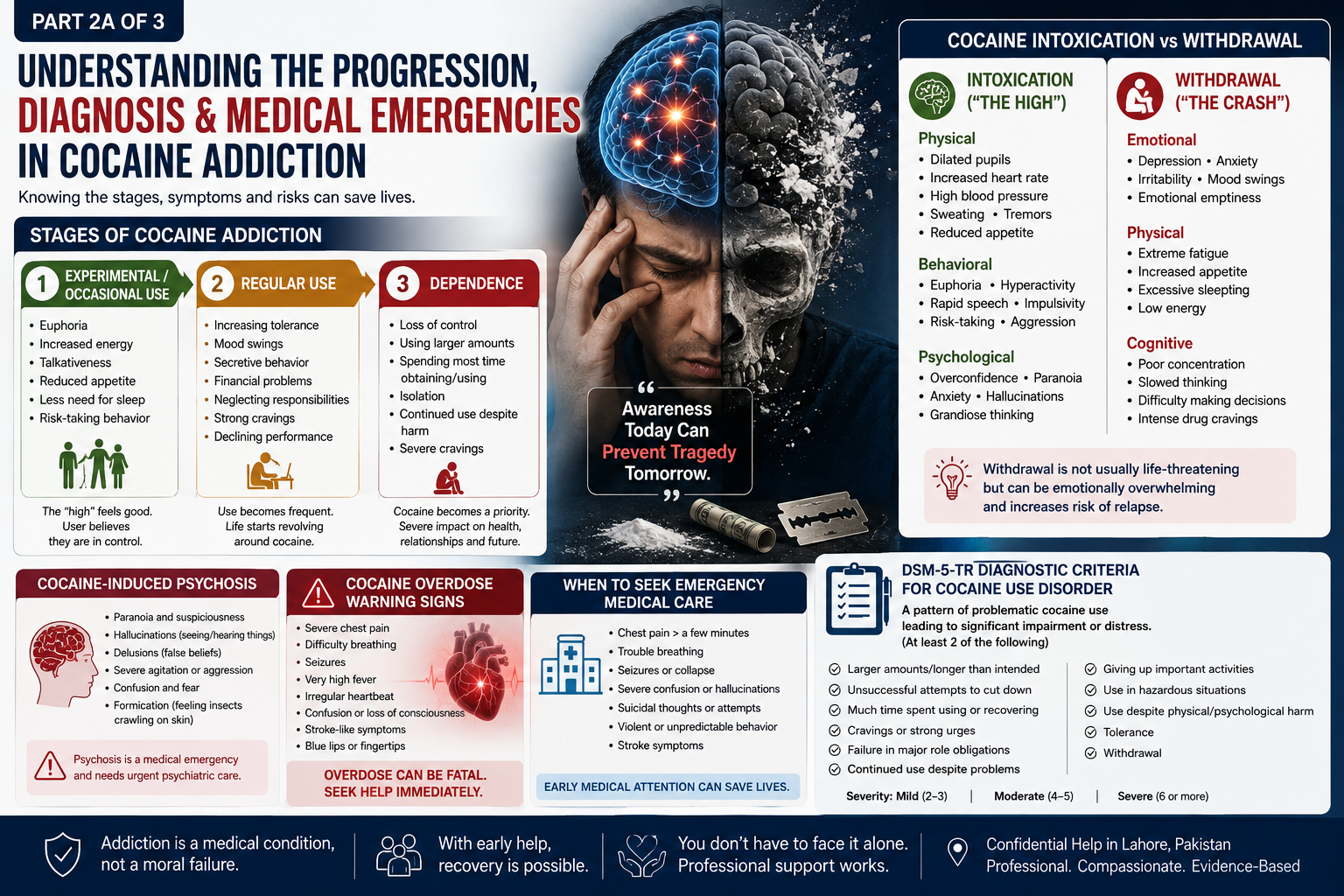
Symptoms According to the Stages of Cocaine Addiction
Cocaine addiction usually develops gradually rather than overnight. Although every individual is different, many people progress through recognisable stages.
Stage 1: Experimental or Occasional Use
During the early stage, cocaine is often used in social settings, parties, or to enhance confidence and energy.
Common symptoms include:
* Increased confidence * Euphoria * Elevated energy * Excessive talkativeness * Reduced appetite * Less need for sleep * Increased sociability * Risk-taking behaviour
At this point, many individuals believe they are “in control.” Because they can still maintain work or academic performance, the risks are often underestimated.
Why this stage is dangerous
Repeated exposure begins altering dopamine pathways in the brain. Even occasional use can increase the likelihood of future cravings and compulsive drug-seeking behaviour.
⸻
Stage 2: Regular Use
As cocaine use becomes more frequent, the brain adapts to repeated dopamine surges. The pleasurable effects become less intense, leading individuals to use larger amounts or use cocaine more often.
Warning signs include:
* Increasing tolerance * Frequent mood swings * Irritability * Anxiety between episodes of use * Secretive behaviour * Financial difficulties * Neglecting responsibilities * Frequent absenteeism from work or school * Declining academic or job performance * Relationship conflicts * Strong cravings
Family members often notice significant personality changes during this stage.
⸻
Stage 3: Cocaine Dependence
At this stage, cocaine becomes the centre of the person’s life.
Common symptoms include:
* Loss of control over cocaine use * Inability to stop despite repeated attempts * Using larger amounts than intended * Spending considerable time obtaining cocaine * Neglecting family and professional responsibilities * Continuing use despite medical or legal consequences * Severe cravings * Social isolation * Emotional instability * Depression during periods without cocaine
Many individuals recognise the harm but feel unable to stop because of overwhelming cravings and changes within the brain’s reward system.
⸻
Cocaine Intoxication vs Cocaine Withdrawal
Families are often confused because the symptoms of intoxication and withdrawal are very different.
Understanding these differences is essential for recognising cocaine addiction.
⸻
Symptoms of Cocaine Intoxication (“The High”)
During intoxication, cocaine overstimulates the central nervous system.
Typical symptoms include:
Physical Symptoms
* Dilated pupils * Increased heart rate * Elevated blood pressure * Sweating * Tremors * Reduced appetite * Increased body temperature * Restlessness
Behavioural Symptoms
* Excessive confidence * Hyperactivity * Rapid speech * Increased sociability * Poor judgement * Impulsive behaviour * Aggression * Risk-taking activities
Psychological Symptoms
* Euphoria * Heightened alertness * Feeling unusually powerful * Grandiose thinking * Anxiety * Suspiciousness
In severe cases, intoxication may progress to medical emergencies requiring immediate treatment.
⸻
Symptoms of Cocaine Withdrawal (“The Crash”)
Unlike opioid withdrawal, cocaine withdrawal is usually not life-threatening. However, it can be emotionally overwhelming and significantly increase the risk of relapse or self-harm.
Common symptoms include:
Emotional Symptoms
* Depression * Hopelessness * Loss of motivation * Anxiety * Irritability * Emotional emptiness
Physical Symptoms
* Extreme fatigue * Increased appetite * Excessive sleeping * Low energy * Slowed movements
Cognitive Symptoms
* Poor concentration * Difficulty making decisions * Slowed thinking * Reduced memory * Strong drug cravings
Withdrawal symptoms often begin within hours after stopping cocaine and may persist for several days to weeks. Psychological cravings can continue for months, particularly when triggered by stress or reminders of previous drug use.
Professional medical supervision and psychological support can make this period safer and reduce the risk of relapse.
⸻
Cocaine-Induced Psychosis
One of the most serious complications of cocaine addiction is cocaine-induced psychosis, a condition in which the drug causes a temporary loss of contact with reality.
Although psychosis is more likely after heavy or prolonged cocaine use, it may also occur after binge use in susceptible individuals.
Common Symptoms
* Extreme paranoia * Believing others are following or spying on them * Hearing voices that are not present (auditory hallucinations) * Seeing things that do not exist (visual hallucinations) * False beliefs (delusions) * Severe agitation * Aggressive or unpredictable behaviour * Confusion * Fearfulness
Some individuals become convinced that insects are crawling under their skin—a symptom known as formication—which may lead to repeated scratching and skin injuries.
Is Cocaine Psychosis Permanent?
In many cases, psychotic symptoms improve after cocaine use stops and appropriate psychiatric treatment is started. However, repeated episodes increase the risk of persistent psychiatric illness and require urgent specialist assessment.
Psychosis should always be treated as a medical emergency.
⸻
Cocaine Overdose Warning Signs
Although many people associate overdose with opioids, cocaine overdose can also be fatal.
An overdose may occur because of:
* Using large quantities * Highly potent or contaminated cocaine * Combining cocaine with alcohol or other drugs * Underlying heart disease * Repeated binge use
Warning Signs
Seek emergency medical care immediately if someone develops:
* Severe chest pain * Difficulty breathing * Very high fever * Severe agitation * Confusion * Seizures * Collapse * Loss of consciousness * Blue lips or fingertips * Weakness on one side of the body * Difficulty speaking * Sudden severe headache * Irregular heartbeat
These symptoms may indicate a heart attack, stroke, seizure, or other life-threatening complication.
Do not wait for symptoms to improve on their own.
⸻
When to Seek Emergency Medical Care
Immediate medical attention is essential if a person using cocaine experiences:
* Chest pain lasting more than a few minutes * Difficulty breathing * Seizures * Loss of consciousness * Severe confusion * Hallucinations with aggressive behaviour * Suicidal thoughts or suicide attempts * Violent behaviour placing themselves or others at risk * Stroke-like symptoms such as facial drooping, arm weakness, or slurred speech
Prompt emergency treatment can be lifesaving.
⸻
Understanding the DSM-5-TR Diagnostic Criteria
Mental health professionals diagnose cocaine addiction using the Diagnostic and Statistical Manual of Mental Disorders, Fifth Edition, Text Revision (DSM-5-TR).
Rather than relying on a single symptom, the diagnosis is based on a pattern of problematic cocaine use that causes significant impairment or distress.
Common diagnostic features include:
* Using cocaine in larger amounts or for longer than intended. * Persistent desire or unsuccessful efforts to cut down or stop. * Spending a great deal of time obtaining, using, or recovering from cocaine. * Intense cravings or a strong urge to use. * Recurrent cocaine use leading to failure at work, school, or home. * Continued use despite ongoing social or relationship problems. * Giving up important social, occupational, or recreational activities. * Repeated use in physically hazardous situations. * Continuing cocaine use despite knowing it is causing physical or psychological harm. * Developing tolerance, requiring more cocaine to achieve the same effect. * Experiencing withdrawal symptoms or using cocaine to avoid withdrawal.
Severity of Cocaine Use Disorder
Based on the number of DSM-5-TR criteria present, clinicians classify cocaine use disorder as:
* Mild: 2–3 criteria * Moderate: 4–5 criteria * Severe: 6 or more criteria
This classification helps guide treatment planning and determine whether outpatient care, intensive therapy, or inpatient rehabilitation is likely to be most beneficial.
⸻
Key Takeaway
Cocaine addiction is a progressive brain disorder that often begins with subtle behavioural changes but can lead to dependence, psychosis, overdose, and life-threatening medical complications. Recognising the stage of addiction, understanding the difference between intoxication and withdrawal, and knowing when to seek emergency medical care can make the difference between timely recovery and preventable tragedy.
Early diagnosis using internationally recognised DSM-5-TR criteria allows individuals to receive evidence-based treatment before addiction causes irreversible harm to their health, relationships, and future.
Related articles
Opioid Dependence Treatment in Lahore | OAMT & Buprenorphine at Mayo Hospital
Research and evidence