
Continue reading from Part 2A: Understanding the Progression, Diagnosis, and Medical Emergencies in Cocaine Addiction
Recognising cocaine addiction is only the first step. The next question many families ask is, “Who is most likely to develop cocaine addiction, and what should we do next?”
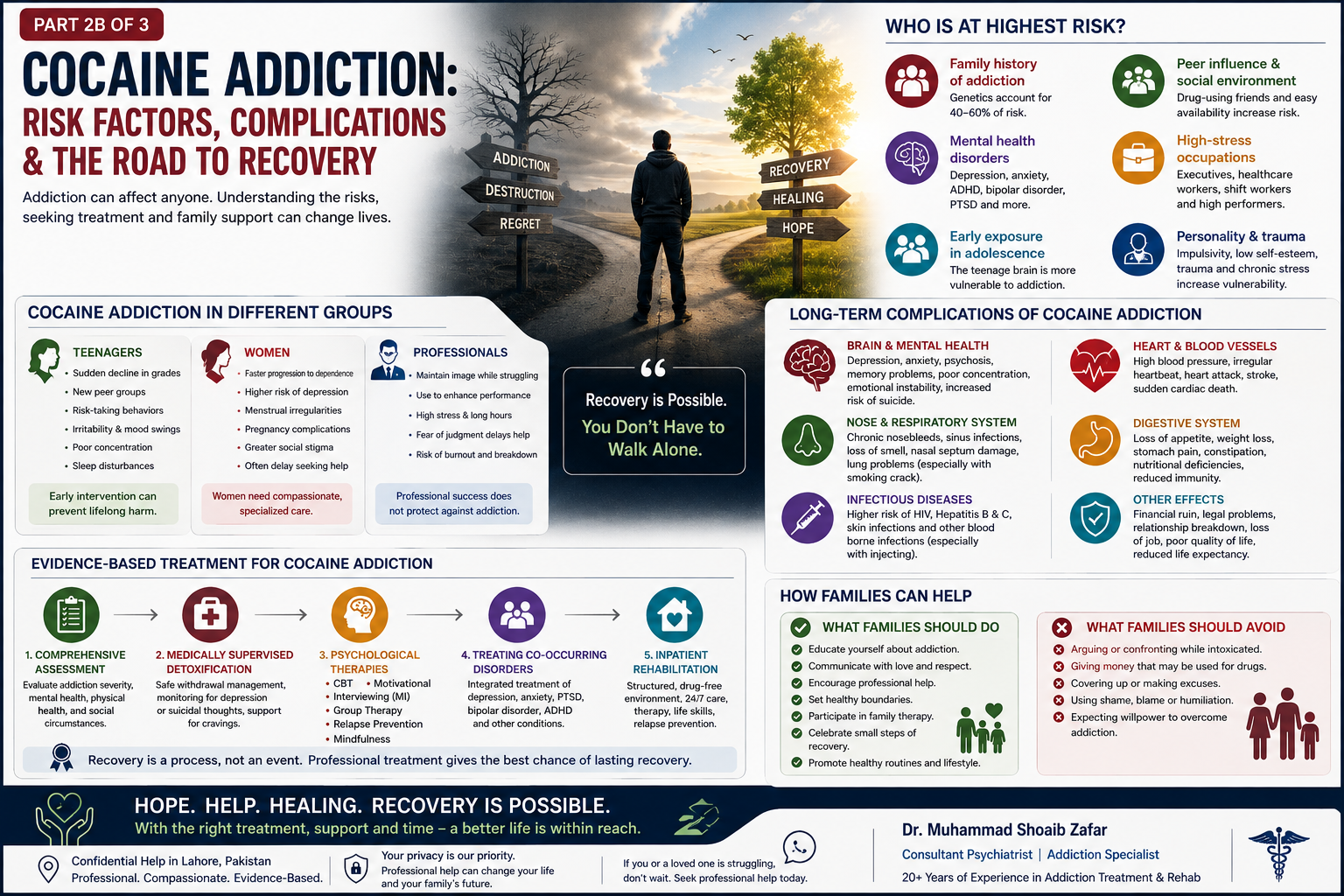
Although cocaine can affect anyone regardless of age, gender, education, or income, certain individuals are more vulnerable because of genetic, psychological, environmental, and social factors. Understanding these risk factors allows earlier intervention and more effective prevention.
⸻
Who Is at Highest Risk of Cocaine Addiction?
Addiction develops through a complex interaction of biology, mental health, personality, and life experiences. Most people who develop cocaine addiction have multiple contributing risk factors rather than a single cause.
1. Family History of Addiction
One of the strongest predictors is a family history of substance use disorders.
Research suggests that genetic factors account for approximately 40–60% of the risk of developing an addiction. However, genetics do not determine destiny. A supportive environment, healthy coping skills, and early intervention can substantially reduce this risk.
⸻
2. Mental Health Disorders
Individuals with untreated mental health conditions are at increased risk of cocaine misuse.
Common co-occurring disorders include:
* Depression * Anxiety disorders * Bipolar disorder * Attention-Deficit/Hyperactivity Disorder (ADHD) * Post-Traumatic Stress Disorder (PTSD) * Personality disorders
Some individuals initially use cocaine in an attempt to improve mood, increase energy, or enhance concentration. Unfortunately, cocaine often worsens these conditions over time and creates a cycle in which drug use and psychiatric symptoms reinforce one another. This combination is known as dual diagnosis and requires integrated treatment addressing both addiction and mental health simultaneously.
⸻
3. Early Exposure During Adolescence
The adolescent brain continues developing into the mid-twenties, particularly the areas responsible for judgment, impulse control, and decision-making.
Young people who begin using cocaine during adolescence are more likely to:
* Develop dependence rapidly * Experience learning and memory problems * Perform poorly at school or university * Engage in risky behaviours * Develop long-term mental health difficulties
Preventing early exposure remains one of the most effective strategies for reducing cocaine addiction.
⸻
4. Peer Pressure and Social Environment
Drug use is strongly influenced by social surroundings.
Risk increases when individuals:
* Spend time with friends who use drugs * Attend environments where cocaine is easily available * Experience workplace cultures that encourage stimulant use * Believe cocaine improves confidence or productivity
Changing the social environment is often an essential part of recovery.
⸻
5. High-Stress Occupations
Professionals working under chronic stress may be at increased risk.
Examples include:
* Healthcare professionals * Business executives * Sales and marketing professionals * Entertainment industry workers * Hospitality workers * Shift workers * Individuals with demanding corporate roles
Some begin using cocaine believing it improves energy or performance. In reality, repeated use impairs concentration, judgment, emotional regulation, and overall productivity.
⸻
Cocaine Addiction in Teenagers
Teenagers may not show the classic signs seen in adults. Instead, addiction often presents through changes in behaviour, personality, and academic performance.
Warning signs include:
* Sudden decline in grades * Skipping classes * New peer groups * Frequent requests for money * Secretive phone use * Staying out late without explanation * Irritability at home * Declining interest in sports or hobbies * Poor concentration * Sleep disturbances
Parents should approach concerns calmly and supportively rather than through confrontation or punishment alone. Early assessment by a qualified mental health professional can prevent long-term harm.
⸻
Cocaine Addiction in Women
Women may experience unique medical and psychological challenges.
Potential consequences include:
* Menstrual irregularities * Increased anxiety and depression * Pregnancy-related complications * Higher rates of trauma-related disorders * Greater social stigma * Delayed help-seeking because of fear of judgment
Women may also progress from occasional use to dependence more quickly than men, a phenomenon sometimes referred to as telescoping. Treatment programs that address trauma, parenting responsibilities, and emotional well-being often improve outcomes.
⸻
Cocaine Addiction in Professionals
Many people wrongly assume that addiction only affects unemployed or socially disadvantaged individuals.
In clinical practice, cocaine addiction is also seen among:
* Doctors * Lawyers * Engineers * Business owners * University students * Corporate executives * Pilots * Financial professionals
These individuals may maintain a successful public image while struggling privately with escalating cocaine use.
Professional success does not protect against addiction. In fact, fear of damaging one’s reputation often delays treatment, allowing the condition to worsen.
⸻
Long-Term Complications of Cocaine Addiction
Without treatment, cocaine addiction can affect nearly every organ system.
Brain and Mental Health
Long-term use increases the risk of:
* Depression * Anxiety disorders * Panic attacks * Cocaine-induced psychosis * Memory impairment * Difficulty concentrating * Reduced decision-making ability * Emotional instability * Increased risk of suicide
Repeated cocaine exposure also alters the brain’s reward pathways, making natural sources of pleasure less satisfying and increasing vulnerability to relapse.
⸻
Heart and Blood Vessels
Cocaine is one of the few drugs capable of causing a heart attack even in young, otherwise healthy individuals.
Possible cardiovascular complications include:
* High blood pressure * Irregular heart rhythm * Heart attack * Heart muscle damage * Stroke * Sudden cardiac death
Any person with chest pain after cocaine use requires urgent medical assessment.
⸻
Nose and Respiratory System
Snorting cocaine repeatedly can lead to:
* Chronic nosebleeds * Loss of smell * Persistent sinus infections * Nasal septum perforation (a hole in the tissue separating the nostrils)
Smoking crack cocaine may also damage the lungs and increase respiratory complications.
⸻
Digestive System
Reduced appetite and poor nutrition commonly lead to:
* Weight loss * Vitamin deficiencies * Abdominal pain * Constipation * Reduced immune function
In severe cases, cocaine can reduce blood flow to the intestines, causing life-threatening complications.
⸻
Infectious Diseases
Individuals who inject cocaine or combine cocaine with other injectable drugs face an increased risk of:
* HIV * Hepatitis B * Hepatitis C * Skin and soft tissue infections
Sharing needles or other injecting equipment should never occur.
⸻
Evidence-Based Treatment for Cocaine Addiction
Recovery is possible, and thousands of people successfully overcome cocaine addiction every year. The most effective treatment plans combine medical care, psychological therapies, family support, and long-term relapse prevention.
Comprehensive Psychiatric Assessment
Every patient should receive a thorough evaluation covering:
* Severity of cocaine use * Mental health conditions * Physical health complications * Suicide risk * Family and social circumstances * Previous treatment history
This assessment forms the basis of an individualised treatment plan.
⸻
Medically Supervised Detoxification
Although cocaine withdrawal is rarely life-threatening, supervised detoxification provides:
* Monitoring for depression or suicidal thoughts * Management of sleep disturbances * Treatment of anxiety * Support for intense cravings * Safe transition into rehabilitation
Detoxification alone is not a cure. It is the first step toward long-term recovery.
⸻
Psychological Therapies
Evidence-based approaches include:
* Cognitive Behavioural Therapy (CBT) * Motivational Interviewing (MI) * Contingency Management * Relapse Prevention Therapy * Family Therapy * Group Therapy * Mindfulness-Based Relapse Prevention
These therapies help individuals understand triggers, develop healthier coping strategies, improve emotional regulation, and strengthen motivation for recovery.
⸻
Treating Co-Occurring Mental Health Disorders
When depression, anxiety, ADHD, bipolar disorder, PTSD, or other psychiatric conditions are present, they should be treated alongside cocaine addiction. Integrated care improves recovery outcomes and reduces the likelihood of relapse.
⸻
Inpatient Rehabilitation
Residential treatment is particularly beneficial for people who have:
* Severe cocaine dependence * Repeated relapses * Cocaine-induced psychosis * Unsafe home environments * Multiple substance use disorders * Significant family conflict * Complex mental health conditions
Inpatient rehabilitation offers:
* A structured, drug-free environment * 24-hour clinical supervision * Individual and group psychotherapy * Family counselling * Relapse prevention training * Planning for long-term recovery
⸻
How Families Can Help
Families often feel frustrated, frightened, or guilty when someone they love develops cocaine addiction. However, supportive family involvement can significantly improve treatment engagement and long-term outcomes.
What Families Should Do
* Learn about addiction as a medical condition. * Encourage professional assessment without judgment. * Communicate calmly and respectfully. * Establish healthy boundaries. * Support attendance at treatment sessions. * Participate in family therapy if recommended. * Celebrate recovery milestones. * Encourage healthy routines such as sleep, exercise, and balanced nutrition.
What Families Should Avoid
* Arguing while the person is intoxicated. * Providing money that may be used to purchase drugs. * Covering up harmful behaviours. * Using shame, blame, or humiliation. * Assuming recovery will happen through willpower alone.
Recovery is a gradual process. Compassion combined with appropriate boundaries is often more effective than confrontation.
⸻
What Does Recovery Look Like?
Recovery involves much more than simply stopping cocaine use. It is a process of rebuilding physical health, emotional resilience, relationships, purpose, and quality of life.
Many individuals experience:
* Better sleep * Improved concentration * Stable mood * Healthier relationships * Enhanced work performance * Greater self-confidence * Renewed enjoyment of everyday life
Relapse can occur, particularly during the early stages of recovery, but it should be viewed as a signal to reassess and strengthen the treatment plan rather than as a personal failure.
⸻
Key Takeaway
Cocaine addiction can affect anyone, but it is both preventable and treatable. Early recognition, comprehensive psychiatric assessment, evidence-based therapies, family involvement, and ongoing recovery support provide the best chance of lasting recovery. Seeking help early not only reduces the risk of serious medical and psychiatric complications but also gives individuals the opportunity to regain control of their lives before addiction causes irreversible harm.
Related articles
Opioid Dependence Treatment in Lahore | OAMT & Buprenorphine at Mayo Hospital
Research and evidence