Cocaine Addiction Symptoms: Early Warning Signs Families Should Never Ignore
“The earlier cocaine addiction is recognised, the greater the chance of preventing life-threatening complications and achieving long-term recovery.”
Cocaine addiction is one of the fastest-growing stimulant-related public health concerns worldwide. Once considered a recreational drug associated with parties and nightlife, cocaine is now affecting students, professionals, business executives, healthcare workers, athletes, and young adults from all socioeconomic backgrounds. What often begins as occasional use for excitement, confidence, or increased productivity can gradually develop into a chronic brain disorder that impacts physical health, mental well-being, relationships, career, and financial stability.
One of the greatest challenges is that cocaine addiction often develops silently. Many individuals appear successful, continue attending work, or maintain social relationships while hiding their drug use. Family members frequently notice subtle behavioural and emotional changes long before discovering cocaine itself. Recognising these early warning signs can lead to timely intervention and significantly improve the chances of recovery.
Addiction is not a lack of willpower or a moral failing. It is a complex medical condition in which repeated cocaine use changes the brain’s reward system, motivation, memory, and decision-making pathways. These changes make quitting difficult without appropriate medical and psychological support.
In this evidence-based guide, we explain the physical, emotional, psychological, behavioural, and cognitive symptoms of cocaine addiction, highlight when families should seek professional help, and discuss why early treatment can save lives.
⸻
What Is Cocaine Addiction?
Cocaine addiction, also known as Cocaine Use Disorder (CUD), is a chronic brain disease characterised by compulsive cocaine use despite harmful consequences.
According to the Diagnostic and Statistical Manual of Mental Disorders (DSM-5-TR), cocaine use disorder exists on a spectrum ranging from mild to severe depending on the number and intensity of symptoms.
People with cocaine addiction often:
* Experience intense cravings * Lose control over the amount used * Spend increasing time obtaining or recovering from cocaine * Continue using despite health, family, legal, or financial problems * Develop tolerance and require larger amounts to achieve the same effect
Understanding addiction as a medical condition helps reduce stigma and encourages individuals to seek evidence-based treatment.
⸻
Why Recognising Symptoms Early Is So Important
Many families wait until addiction becomes severe before seeking help. Unfortunately, delayed treatment increases the risk of:
* Heart attack * Stroke * Cocaine-induced psychosis * Depression * Suicide * Violence * Relationship breakdown * Financial ruin * Job loss * Criminal involvement * Accidental overdose
Early identification allows intervention before these devastating complications occur.
⸻
How Cocaine Affects the Brain
To understand the symptoms of cocaine addiction, it is important to understand what happens inside the brain.
Normally, the brain releases dopamine—a neurotransmitter responsible for pleasure, motivation, learning, and reward. After dopamine completes its function, it is recycled.
Cocaine blocks this recycling process, causing dopamine to accumulate between nerve cells.
The result is an intense but short-lived “high” characterised by:
* Euphoria * Increased confidence * Elevated energy * Reduced fatigue * Heightened alertness
Repeated exposure forces the brain to adapt by reducing its natural dopamine production and making dopamine receptors less sensitive.
Over time, individuals begin needing cocaine not to feel euphoric—but simply to feel normal.
This process explains why addiction develops and why stopping cocaine can feel emotionally and physically overwhelming.
⸻
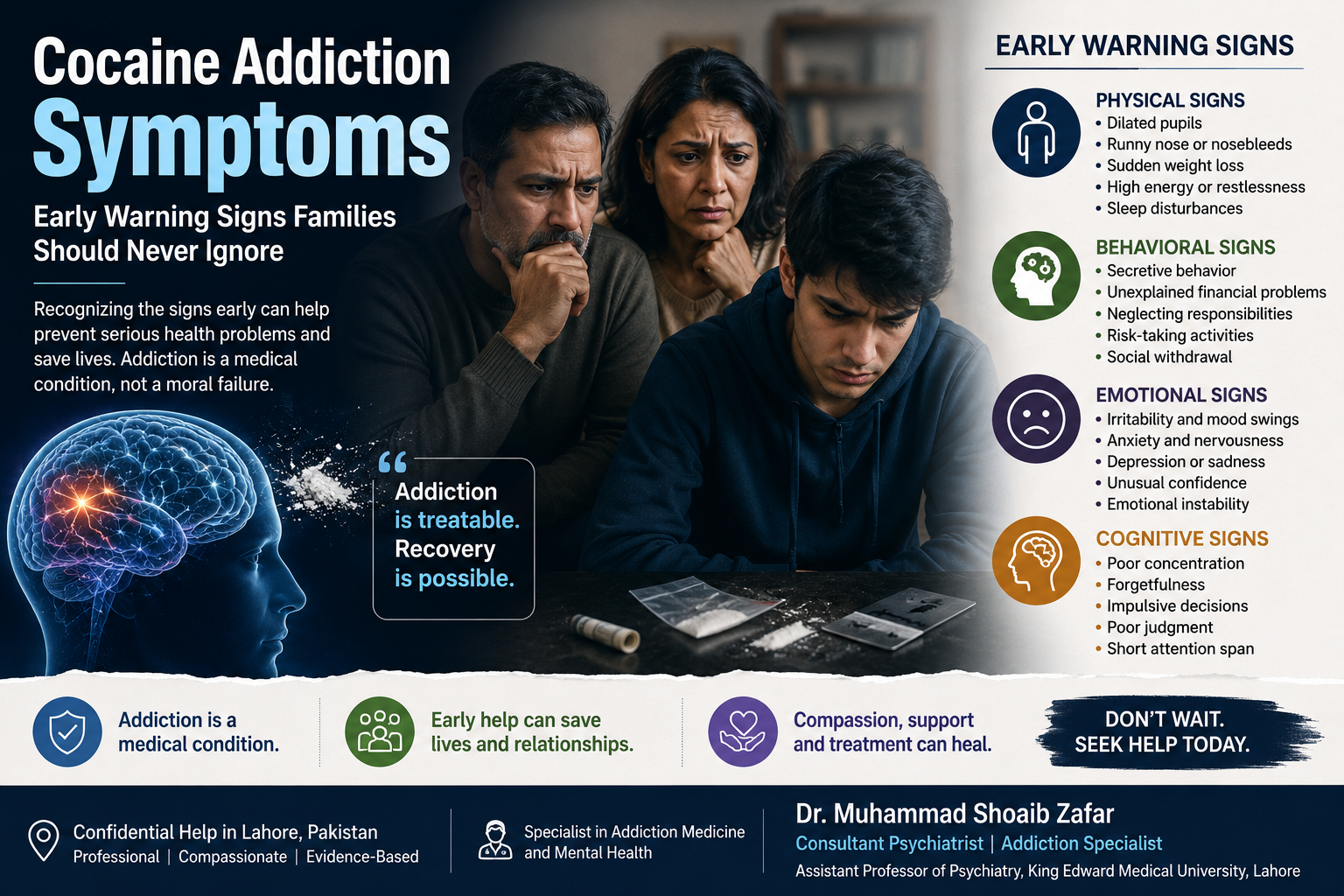
Early Warning Signs Families Should Never Ignore
The earliest symptoms are often subtle.
Instead of obvious drug use, families may notice changes in behaviour, emotions, sleep, finances, and personality.
These changes usually worsen gradually.
⸻
Physical Symptoms of Cocaine Addiction
Physical changes often appear before addiction is openly recognised.
Frequently Dilated Pupils
One of the most noticeable signs is unusually large pupils, particularly in bright light.
Individuals may appear unusually alert or excited.
⸻
Frequent Runny Nose or Nosebleeds
People who snort cocaine commonly develop:
* Frequent nosebleeds * Persistent runny nose * Nasal irritation * Difficulty smelling * Chronic sinus infections
Long-term use may even damage the nasal septum.
⸻
Rapid Weight Loss
Cocaine suppresses appetite.
Many users experience:
* Significant weight loss * Skipped meals * Nutritional deficiencies * Muscle wasting
Friends often comment that the person “looks thinner” without understanding the underlying cause.
⸻
Sleep Disturbances
Cocaine dramatically disrupts normal sleep.
Common symptoms include:
* Staying awake all night * Sleeping very little * Restlessness * Insomnia * Sleeping excessively after drug use (“crash”)
This pattern often repeats itself.
⸻
Increased Heart Rate
Users may experience:
* Fast heartbeat * Palpitations * High blood pressure * Chest discomfort * Sweating
These symptoms require urgent medical attention if severe.
⸻
Excessive Energy
Initially the person may seem:
* Extremely productive * Hyperactive * Overly talkative * Restless * Unable to sit still
Family members sometimes mistake these behaviours for improved motivation.
⸻
Behavioural Symptoms
Behavioural changes often provide the strongest clues that addiction is developing.
Secretive Behaviour
People may begin:
* Locking doors * Hiding phones * Deleting messages * Becoming defensive * Lying about their whereabouts
These behaviours are usually attempts to conceal drug use.
⸻
Sudden Financial Problems
Cocaine addiction is expensive.
Warning signs include:
* Borrowing money repeatedly * Selling valuables * Unexplained debt * Missing household funds * Frequent ATM withdrawals
⸻
Neglecting Responsibilities
Performance often declines in:
* Work * University * Family life * Parenting * Household responsibilities
Deadlines are missed and reliability decreases.
⸻
Risk-Taking Behaviour
Cocaine reduces judgement and increases impulsivity.
Individuals may:
* Drive recklessly * Gamble excessively * Engage in unsafe sexual behaviour * Participate in violent confrontations * Make impulsive financial decisions
⸻
Social Withdrawal
Many people gradually distance themselves from:
* Family * Old friends * Religious activities * Sports * Healthy hobbies
Instead, they spend increasing time with people who use drugs.
⸻
Emotional Symptoms
One of the earliest signs families notice is a dramatic change in emotional stability.
Common symptoms include:
* Irritability * Mood swings * Unusual confidence * Aggression * Anxiety * Restlessness * Emotional sensitivity
These emotional shifts often occur because cocaine disrupts the brain’s natural regulation of dopamine and other neurotransmitters.
⸻
Psychological Symptoms
As addiction progresses, psychological symptoms become more obvious.
These may include:
Anxiety
Many individuals develop:
* Constant worry * Panic attacks * Feeling “on edge” * Difficulty relaxing
Ironically, some continue using cocaine believing it relieves anxiety when it is actually worsening it.
⸻
Depression
Following cocaine use, many people experience:
* Sadness * Hopelessness * Loss of motivation * Emotional emptiness * Thoughts that life has lost meaning
This “crash” often encourages further cocaine use, creating a dangerous cycle.
⸻
Intense Cravings
Cravings are one of the defining symptoms of addiction.
Triggers include:
* Stress * Money * Weekends * Certain friends * Specific locations * Alcohol use * Emotional conflict
These cravings can feel overwhelming without professional support.
⸻
Suspiciousness
Some individuals become unusually suspicious.
They may believe:
* Others are talking about them * Family members are watching them * Police are following them * Friends are plotting against them
Persistent paranoia requires urgent psychiatric assessment.
⸻
Cognitive Symptoms
Cocaine also affects thinking and decision-making.
Families may observe:
* Poor concentration * Forgetfulness * Impulsive decisions * Difficulty planning * Reduced judgement * Short attention span * Poor problem-solving ability
These changes occur because cocaine affects the prefrontal cortex—the area responsible for executive functioning.
⸻
A Message for Families
Perhaps the most important lesson is this:
No single symptom confirms cocaine addiction. However, when several physical, behavioural, emotional, and cognitive changes occur together, especially alongside unexplained financial problems or secrecy, families should seek a professional assessment without delay.
Early intervention is not about punishment or blame. It is about recognising addiction as a treatable medical condition and providing the support needed before the consequences become more severe.
⸻
Coming in Part 2
* Symptoms according to stages of cocaine addiction * Cocaine intoxication vs withdrawal symptoms * Cocaine-induced psychosis * Cocaine overdose warning signs * When to seek emergency medical care * DSM-5 diagnostic criteria explained * Who is at highest risk? * Effects on teenagers, women, and professionals * Long-term complications * Evidence-based treatment options * Family intervention strategies * Scientific references integrated throughout
Related articles
Opioid Dependence Treatment in Lahore | OAMT & Buprenorphine at Mayo Hospital
Research and evidence