
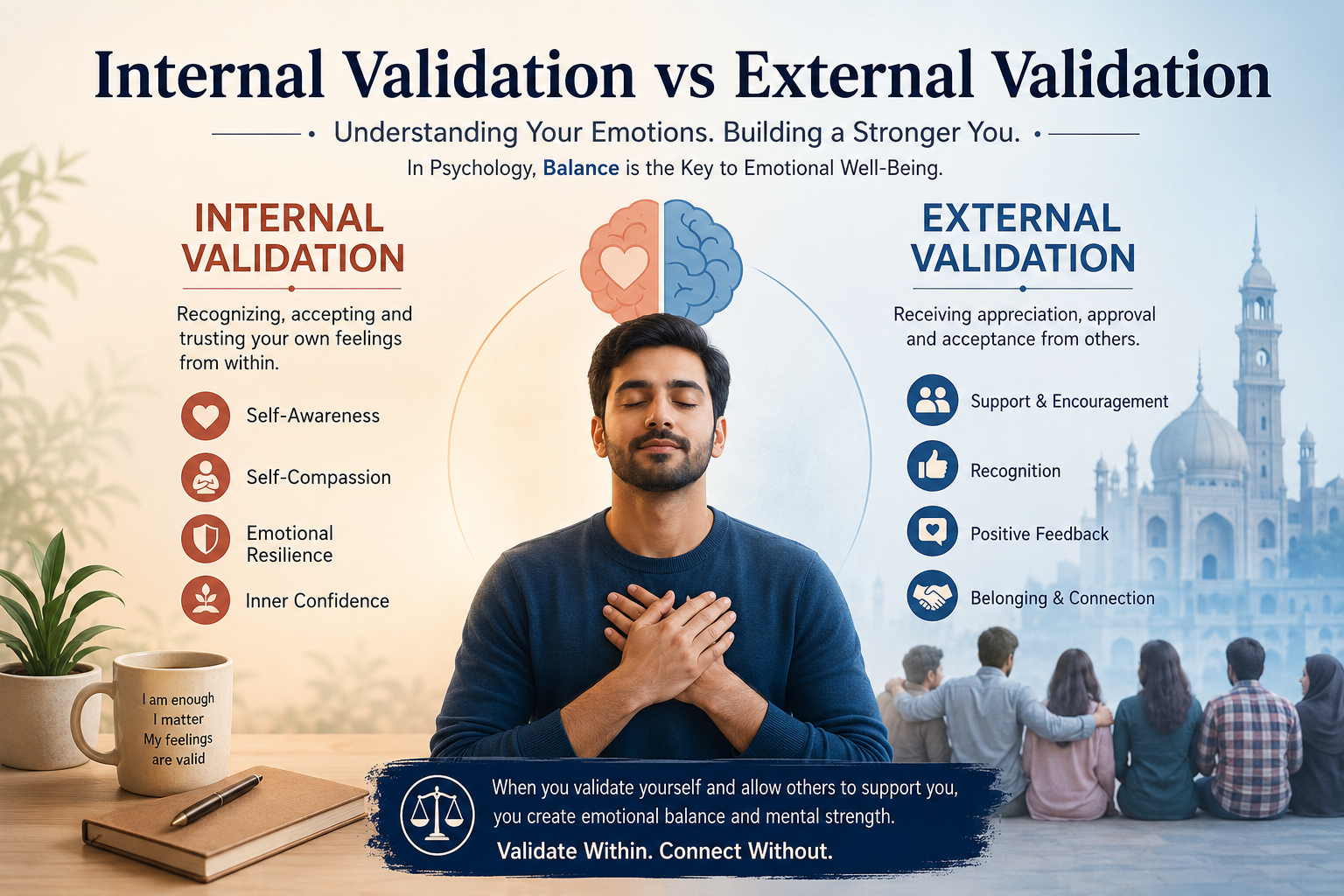
Title: Internal Validation vs External Validation in Psychology | Understanding Emotions the Healthy Way
Description: Learn the difference between internal and external validation in psychology. Discover how healthy self-validation improves emotional well-being with simple Pakistani examples and evidence-based insights.
Internal Validation vs External Validation: Why Your Emotional Well-Being Depends on Both
Imagine this situation.
You worked hard on an important presentation. After finishing, your first thought is:
“I did my best, and I’m proud of my effort.”
Now imagine another person thinking:
“I’ll only feel good if everyone praises me.”
Both people completed the same task, but their emotional experiences are completely different.
The difference lies in internal validation and external validation.
In psychology, these concepts play a major role in self-esteem, emotional regulation, resilience, relationships, anxiety, depression, perfectionism, and recovery from trauma. Understanding them can transform the way we relate to ourselves and others.
⸻
What is Internal Validation?
Internal validation means recognizing, accepting, and understanding your own emotions, thoughts, and experiences without needing someone else to approve them first.
It does not mean believing that every thought is correct.
Instead, it means saying:
“My feelings are real, understandable, and deserve compassion.”
Healthy internal validation allows us to experience emotions without becoming overwhelmed by them.
⸻ A Simple Example
A medical student in Lahore studies for months but narrowly misses a competitive examination.
Internal validation sounds like:
“I’m disappointed, and that’s understandable. I worked hard. One result does not define my worth. I can learn from this experience.”
This approach acknowledges the emotion without turning it into self-criticism.
⸻ What is External Validation?
External validation refers to receiving reassurance, appreciation, acceptance, or approval from other people.
Examples include:
* Compliments from family * Likes on social media * Praise from teachers * Recognition at work * Appreciation from patients * Encouragement from friends
External validation is a normal psychological need. Humans are social beings, and healthy relationships naturally involve emotional support.
However, problems arise when external validation becomes the primary source of self-worth.
⸻ Everyday Pakistani Example
A young professional uploads a photo on social media.
If the post receives many likes, they feel confident.
If it receives little attention, they spend the entire day feeling unattractive or unsuccessful.
Their mood has become controlled by external validation rather than their own self-worth.
⸻
Why Internal Validation Matters
People with strong internal validation tend to:
* Recover more quickly from criticism. * Have healthier self-esteem. * Experience less anxiety. * Build more secure relationships. * Make decisions based on personal values instead of social pressure. * Cope better with setbacks.
Research in emotion regulation, self-compassion, and cognitive behavioural therapy (CBT) consistently shows that people who acknowledge and accept their emotions experience better psychological well-being than those who constantly suppress or judge them.
⸻
Why External Validation Also Matters
Although internal validation is important, humans are not meant to live emotionally isolated.
Supportive relationships provide:
* Comfort during grief * Encouragement during recovery * Motivation during difficult times * A sense of belonging * Emotional safety
For example, a person recovering from depression may benefit enormously when family members say:
“We’re here for you. You’re not alone.”
This healthy external validation reinforces hope without replacing the person’s own inner strength.
⸻
When External Validation Becomes Unhealthy
Difficulties arise when someone believes:
* “I’m only valuable if people admire me.” * “If someone criticizes me, I must be a failure.” * “My happiness depends entirely on other people’s opinions.”
This pattern may contribute to:
* Anxiety disorders * Depression * Perfectionism * Social anxiety * Burnout * Low self-esteem * Emotional dependency * Relationship difficulties
In today’s digital world, excessive dependence on social media approval has intensified these struggles, particularly among adolescents and young adults.
⸻
Internal Validation in Relationships
Imagine a husband forgets his wife’s birthday.
The wife feels hurt.
Healthy internal validation sounds like:
“My feelings are understandable. I feel disappointed because this day is important to me.”
She recognizes her emotions before reacting.
Healthy external validation occurs when the husband responds:
“I understand why you’re hurt. I’m sorry. Your feelings make sense.”
Notice that both forms of validation are needed.
One comes from within.
The other strengthens emotional connection.
⸻
Parenting Example
A child comes home crying after losing a cricket match.
An invalidating response would be:
“Stop crying. It’s just a game.”
A validating response would be:
“I can see you’re disappointed. Losing hurts when you’ve tried your best.”
This does not encourage weakness.
Instead, it teaches emotional awareness and resilience.
Children who repeatedly experience emotional validation generally develop healthier emotional regulation and stronger self-confidence.
⸻
The Science Behind Emotional Validation
Modern psychological therapies emphasize validation as a cornerstone of emotional health.
Research suggests that emotional validation:
* Reduces emotional intensity * Improves emotional regulation * Enhances resilience * Strengthens therapeutic relationships * Promotes psychological flexibility * Supports recovery from anxiety and depression
Validation is a key component of evidence-based approaches such as:
* Dialectical Behaviour Therapy (DBT) * Cognitive Behavioural Therapy (CBT) * Acceptance and Commitment Therapy (ACT) * Compassion-Focused Therapy (CFT)
These therapies teach individuals to acknowledge emotions without allowing those emotions to dictate every decision.
⸻
Internal Validation vs External Validation
Internal Validation External Validation Comes from yourself Comes from other people Builds lasting self-esteem Builds connection and belonging Encourages emotional resilience Provides emotional support Based on self-compassion Based on empathy and acceptance Remains stable despite criticism Changes depending on others’ responses
⸻
Finding the Right Balance
The healthiest emotional life is not choosing one over the other.
Instead:
* Validate your own emotions. * Accept support from others. * Learn from constructive feedback. * Avoid basing your entire identity on approval or criticism.
Think of internal validation as the roots of a tree and external validation as sunlight and rain.
A tree needs both to thrive.
Without strong roots, even abundant sunshine cannot keep it standing during a storm.
⸻
Final Thoughts
Emotional maturity is not about ignoring your feelings or pretending to be strong.
It is about recognizing your emotions with kindness while remaining open to healthy support from the people who care about you.
Remember:
Internal validation says, “My feelings matter.”
External validation says, “Your feelings matter to me.”
When both are present in balance, they create the foundation for emotional resilience, healthier relationships, and lasting psychological well-being.
⸻
About the Author
Dr. Muhammad Shoaib Zafar Consultant Psychiatrist | Addiction Specialist | Child & Adolescent Psychiatrist | Psychotherapist
Helping individuals and families build healthier minds through evidence-based psychiatric care, psychotherapy, and compassionate emotional healing.
Internal Validation vs External Validation in Psychology | Understanding Emotions the Healthy Way
What is Internal Validation?
What is External Validation?
Why Internal Validation Matters
- * Recover more quickly from criticism.
- * Have healthier self-esteem.
- * Experience less anxiety.
- * Build more secure relationships.
- * Make decisions based on personal values instead of social pressure.
- * Cope better with setbacks.
Related articles
CBT vs DBT: Which Therapy Approach Is Right for You?
How Psychotherapy Works: What to Expect From Your First Session
Research and evidence